Andy O’Brien Says:
With so many other cities regarding the game as dead or dying
Vol. 7, No. 31, 1957
Weekend Magazine
LOOKING for the baseball story of ’57? Even if Don Larsen comes up with a “perfect” double-header, he won’t change my mind. Win, lose or draw in the Pacific Coast League this season, I’m voting for the Vancouver Mounties.
Reason? I‘m sick of “expert observers” giving up on baseball as dying or dead. As a contrast, the dodo was a live bird compared to baseball in Vancouver, yet sheer determination and imaginative leadership have blithely boomed it back from the baseball boneyard. Look at the record:
l. Three years ago baseball in Vancouver folded with the Western International (Class A) loop.
2. Oakland, Cal., a P.C.L. (Open Classification) franchise that had been wobbling since pennant-winning Casey Stengel left after 1948 for the Yankees, went on the market – $50,000 cash plus $100,000 in debts. Vancouver launched a shares drive, raised $175,000 and yipped gleefully into the Pacific Coast League.
3. Oakland, turned into Vancouver Mounties, transformed everything into a near-debacle in 1956 by ending last, 38½ games behind the leaders, and a whopping $100,000 in debt.
4. Mounties started this season with a renewed shares drive, a new president, a general manager and manager nobody had ever heard of, only four players from the 1956 team and a drag-’em-out court battle with the Lord’s Day Alliance, who were out to ban ball on Sundays, the biggest earning day of the week.
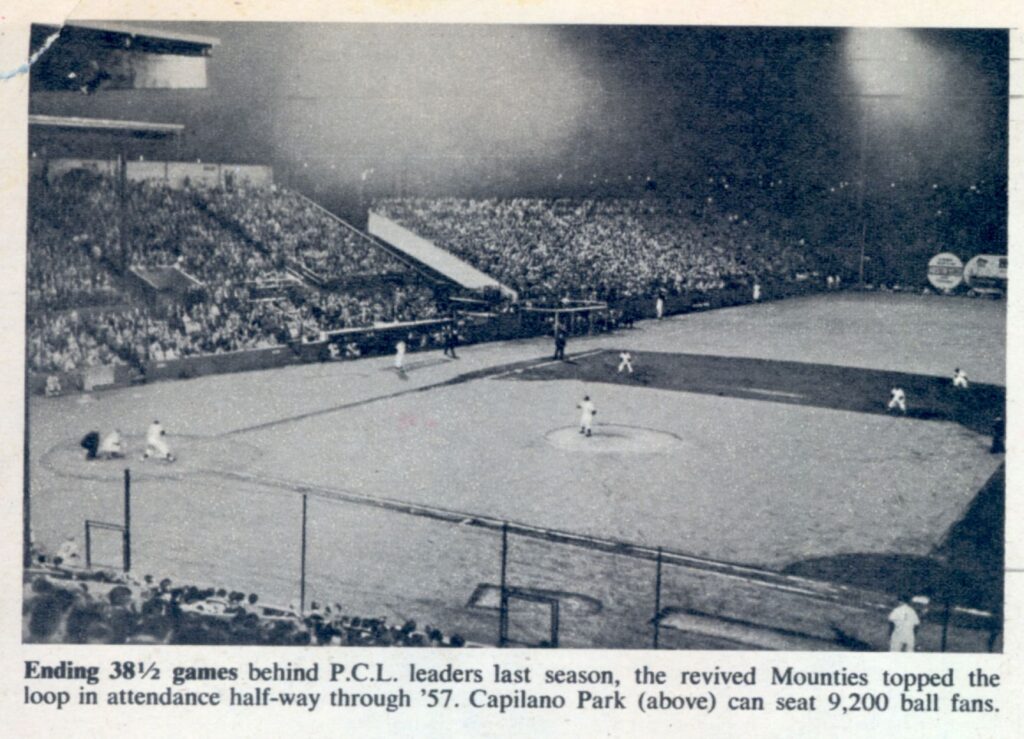
5. By the end of the seventh week of the current season, the Mounties had galloped to within a nose of first place, the city-owned Capilano Stadium had drawn more than any other park in the P.C.L. (including Los Angeles and San Francisco) with a 40,725 increase over the corresponding period in I956. At the half-way mark with the boom showing every indication of continuing, I found Vancouver looking a little starry-eyed toward a major league tomorrow.
Can you blame me for voting – right now?
The name of Nat Bailey is closely interwoven in the whole story. His interest in baseball started as a peanut-vendor in Vancouver parks. The years saw him exchange his peanut basket for a chain of restaurants which helped him accumulate a fortune said to run into a couple of million dollars. But he never lost his fan-bug for baseball and has been sponsoring kid teams ever since. It was Nat who worked out the deal for Oakland. When the Oakland team came north, its president, Brick Laws, came with it. But Laws didn’t click – in fact, the Vancouver Sun baseball writer quit in protest. Nat took over from Laws as president, but Laws had done one good turn in urging the hiring of Cedric Tallis as general manager of the team.

Nobody had ever heard of Tallis but he soon made ‘em forget it. The guy gives out charges of electricity when he talks – example: When somebody said, “You can’t win them all,” Tallis snapped: “Why not?”
He delighted all British Columbia by sending his pal, Lefty Gomez, a frozen, 40-pound salmon with a note: “This is what we use for bait up here.”
Background? Tallis‘ mother came from Gaspe, Que. His father from Birmingham, Eng. He was born in New York City. During the war, he worked up from private to major in the U.S. infantry and married a girl in London, Eng. Through friend Red Rolfe, farm director of the Detroit Tigers’ organization, he got into the administrative side of baseball, working his way through Texas, Oregon and Washington into B.C. He had picked up a lot of big baseball friends on the way, such as Joe Cronin, who ‘came in plenty handy when it came to getting new mounts for the Mounties. But much as Vancouver was taken by Tallis, the fans had reason to think a rock had been pulled when Tallis announced his new manager, Charlie Metro.
WITH the firing of former major-leaguer Lefty O’Doul, another big name had been expected – even Dodgers’ Jackie Robinson had been mentioned. But nobody had ever heard of Metro. In fact, nobody had ever even heard of improbable Nanty-Glo, Pa., where Metro – real name, Moreskonich – was born. He had an unimpressive pedigree with the Tigers and Philadelphia A’s, had been everywhere in the last 20 years. But Tallis said Metro was his man, asked him what he wanted and went after it. Metro promptly turned into the apple of Vancouver’s eye with a gambling, swashbuckling type of diamond action that had a player with a walk dashing for first as if to beat out a bunt. And bunts he uses by the bunch. His pitchers pitch to the heavy hitters. He hollered so much it looked as if Metro was out to beat the record he set for fines in the Sally League, but when Tallis tried to have him insured with Lloyd’s of London for anything over$500 a crisp reprimand came from P.C.L. president Leslie O’Connor. Obvious from the start was the contagious feeling that his hustling team, including nine with major-league experience, is having fun.

Fan fun is stimulated by a Booster Club headed by Vancouverite Phil Wood to sell ducats while lining up “Meet The Players” nights with buffet-dances.
The row with the Lord’s Day Alliance has developed legal complications which have long since defied the understanding of the average fan. A majority of Vancouverites voted for Sunday sport in a plebiscite but the Alliance was responsible for a situation wherein the Mounties have been selling tickets for Sunday games on Saturdays-none at the box office on Sunday. The Mounties have argued that their “commercialized business” is no different from the Vancouver Symphony concerts, pony rides in Stanley Park and the bowling alleys which are open on Sundays. While the case will possibly go to the Appeal Court late this year, it has taken some amusing twists, such as when sports editor Jack Richards of the Sun found an Alliance letter which said in part: “They (the Mounties) do not represent the R.C.M.P. at all.” Richards rasped: “Mounties never claimed sponsorship of the R.C.M.P. Neither are the San Francisco Seals fur-bearing, the Washington Senators real senators, nor the Edmonton Eskimos genuine Eskimos.”
From out of a 10-year retirement, Tallis brought Bill Sayles, ex-pitcher with Giants and Dodgers, to build up minor ball in the province. The provincial Department of Education is currently paying the shot for nine clinics conducted by Sayles – the first such link between a government and pro club in history. Today in Greater Vancouver alone there are 2,500 kids playing in organized leagues. Says Sayles: “The climate here is no different from that of the states of Washington and Oregon, which each produce l0 major-league players a year. B.C. kids need only coaching, they’re already tough.”
TALLIS’ thinking on the future is just as refreshing: “Major ball will have to start planning in terms of Inter-Continental Baseball. My idea would be a third major league comprising four teams on the Pacific coast and four through Hawaii and the Orient – an idea proven sound by the huge crowds attending the Yankee and Dodger tours. The jet-plane era will re-move travel difficulties.”
You find yourself recalling Vancouver’s feat in staging the British Empire Games classic of “Miracle Mile” fame in 1954, its feat in coming up from nowhere with the richest football team of Canada’s Big Nine in three years and now this Back from the Baseball Boneyard saga. Instead of tsk-tsking Tallis, you exclaim: “Why not?”