At the National Hockey League “closed” practices you find
There’s More To “Big Time” Coaching
By Andy O’Brien
Jan. 7, 1961
Montreal Standard
 |
This may sound silly, folks, but after sitting through some 600 practices – usually closed to the general public – and more than 1,000 games in the six rinks of the National Hockey League, I’m beginning to suspect I enjoy practices more.
And why?
Practices show you more about the basic skills and stratagems of the hockey “Big Time.” Nowadays everything happens so fast in regular games it often seems that the goals emerge from chaos. But seated in the relaxed atmosphere of an almost-empty rink without game pressure, you watch the coaches experimenting and rehearsing techniques, not unlike the repetitious drilling of Broadway stage directors, to iron out flaws and evolve patterns of play. Even today, after 28 years of watching games from the press boxes up top, I find myself learning anew the science so many see as “mere shinny.”

For instance, one morning at the Detroit Olympia watching Red Wings practise, I learned the technique behind the apparently foolhardy and matter-of-luck business of a defenceman going down on his knees directly in front of (and facing) an opponent in the act of shooting.
The trick is to watch the puck-carrier’s eyes. He’ll drop his eyes to the puck just before shooting.
When his eyes drop, you start to drop, too – not before, because if you drop too soon the puck-carrier may veer around you instead of shooting, leaving you saying your prayers on lonely ice.
But now for the sequel, courtesy of Coach Sid Abel: “We try to get our forwards into the habit of lifting their eyes for a quick peek after lowering them for the shot, just hoping the opposing defenceman has been deked into falling early.”
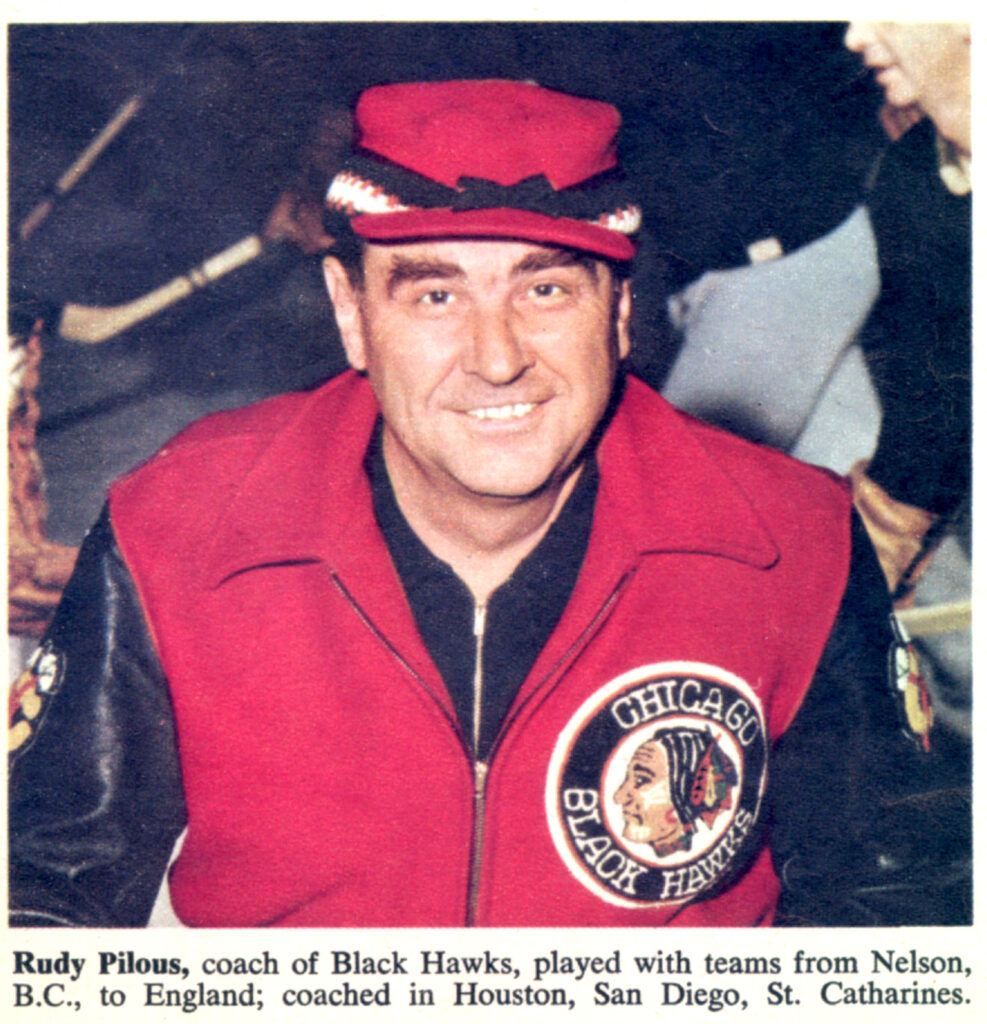
In the vast Chicago Stadium you’re just as liable to hit upon an astonishing sight during a Black Hawks practice. One of Coach Rudy Pilous’s pet stunts (when his teams aren’t checking) is to form two teams on the ice and allow one team only two sticks, carried by goaler and centre. It’s almost unbelievable how seldom the fully-equipped team scores. Pilous’s point, of course, is to
impress on players how they can check if they only concentrate on checking.
At a Canadiens practice with the madding throng absent from the Montreal Forum, don’t be surprised if you hear Coach “Toe” Blake ordering some of his famed scorers to “forget the opposing net.”
He explains: “Most fans judge a forward by his scoring. But if his opposing covers have totalled as much as he has, the over-all result is poor. Top-scoring lines are often the most scored against as well. Last season we ended first, yet the tail-end Rangers were the only team to break even with us in the 14 times we met. Meaning only one thing: we let down defensively against Rangers.”
Blake adds: “Sometimes when a line isn’t doing well defensively it’s not their fault. Maybe it’s the coach’s in not putting players who jell together on the same line.”
Incidentally, “Rocket” Richard was Blake’s pride and joy in this regard. Even playing only 51 games last year, the Rock scored 19 while his cover scored merely five. In the first of Blake’s five triumphant Canuck campaigns, when Rock played in all 70 games (1955-56), it was 38 goals for, only 13 against.
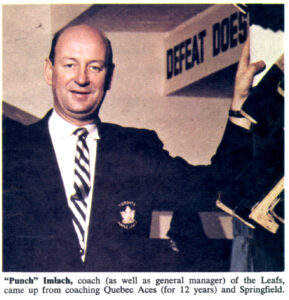
At Maple Leaf Gardens in Toronto, you’re bound to hear Coach “Punch” Imlach harping on positional hockey. Certainly he’s made it pay off.
For the two seasons before he took over Leafs, they ended out of the playoffs – didn’t have a player among the Top Ten in scoring or a player on either first or second All Stars. In the two seasons under Imlach, they’ve ended in the
Stanley Cup finals both times, although still not having a Leaf in the Top Ten and only one making the second All Stars (Allan Stanley last spring).
The difference had to be Imlach and positional hockey. Its advantages offensively are obvious if you want an organized attack while, defensively, when the puck suddenly changes possession, you’re in a better position to catch the player you’re assigned to cover.
Back in 1952 when Imlach was coaching Quebec Aces, I was preparing a feature on a promising young player named Jean Beliveau. I recall that, at a practice, I heard Imlach tell the boys: “Never give up when chasing a puck-carrier-most of them slow up at the opposing blue line and if you skate all-out you’l1 likely catch them.”
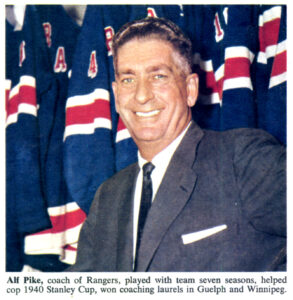
At Madison Square Garden you’ll find Coach Alf Pike pushing the principle that “the best defence is a good offence – keep the puck in their end 70 per cent of the time and they sure can’t score much.” Thus his practices stress “offensive checking” – going in after the opposing team before they get into your end.
At Boston Garden you soon sense why Coach Milt Schmidt is an institution with Bruins, whose uniform he first donned just less than a quarter-century ago. Invariably he blends stiff practices with a bit of fun- “if the boys don’t have some fun they won’t enjoy practice. You can’t keep up a life-and-death atmosphere through a 70-game schedule.”
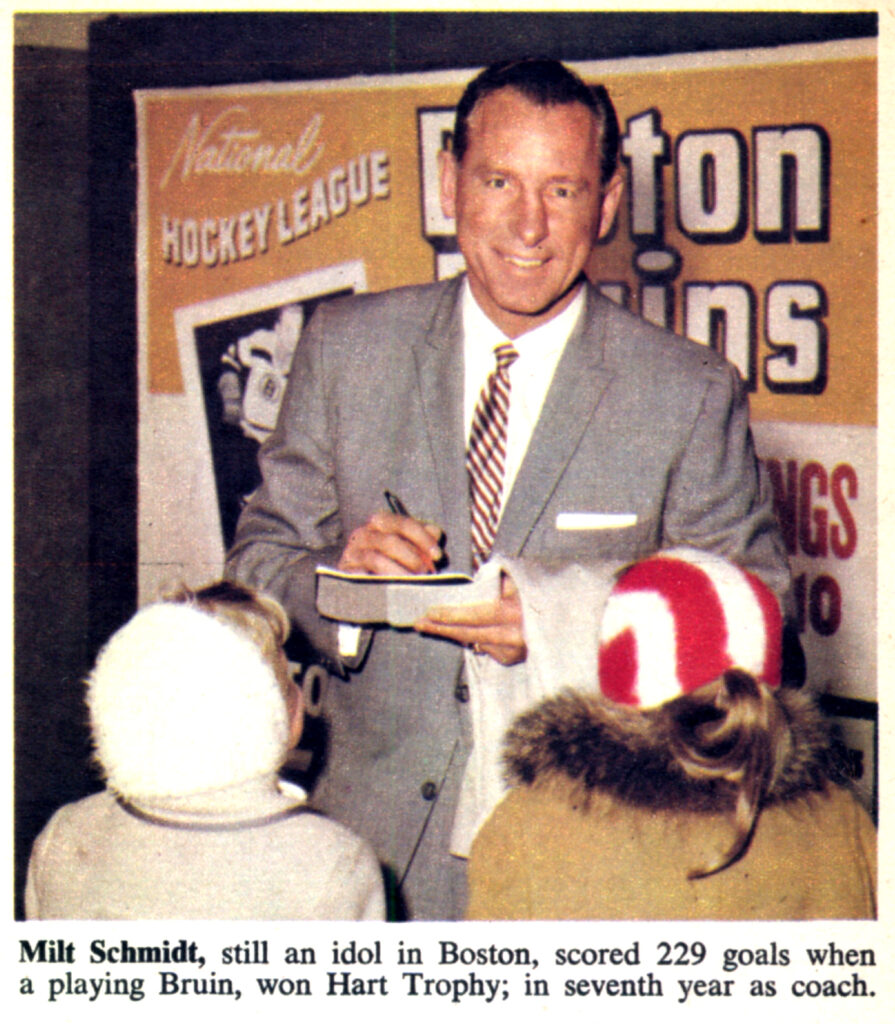
One of the Bruins stars told me of an incident this season that reflects on Schmidt’s psychological savvy. Bruins blew a game in Detroit after leading 5-2 at the end of the second. Milt choked back a natural desire to pull the players apart, simply told them what time they had to be at the plane. There was no joking, little talk, on the flight home. Next morning at practice he called them into a huddle on the ice and said quietly:
“What happened last night can happen again, but let’s make sure it happens to the other team. With me, it’s water under the bridge. Now let’s go get Black Hawks here tomorrow night.”
Bruins blanked the Hawks 4-0, and several players slipped up to thank Milt for not laying into them “because we felt as bad as you did.”
President Clarence Campbell of the N.H.L. once told me he doubts if any coach in any other sport is called upon for the mental alertness and quick decisions required of an N.H.L. pilot. Football and baseball bosses, for example, work from stationary starts, but in hockey coaches are forced to make moves “on the fly.”
Abel moans: “Sure, we aim at Bobby Hull when playing Hawks -and we like to put Norman Ullman on him. But try to get Ullman out there when the play stays away from your bench and Hull is loose against a tired Wing.”
The best example I recall in that category involved Canadians’ late Dick Irvin, one of coaching’s all-time greats, in the last game of the 1952-53 season. It was at Detroit and it was a “nothing” game (couldn’t affect standings), with the spotlight centred exclusively on Red Wings’ Gordie Howe, who had 49 goals and needed only one to tie, two to beat, the all-time season’s record of 50 held by the Rocket.
Before leaving Montreal, the publicity-wise Irvin announced he would shift Richard from right to left wing to cover Howe personally. It sounded like a good idea but when he entered the dressing room in Detroit his heart sank. After nine years with Richard he had grown to recognize signs of an impending explosion. And Richard was sitting there, dour and ominous, after several recent scenes with referees. But what was even worse was the fact that he was now faced with the prospect of losing his cherished record.
Irvin was in a dilemma. If a row broke out in this “nothing” game it could mean the loss of Richard (through suspension) and loss of the Stanley Cup series. If he didn’t play Richard and Howe broke the record, would it affect the morale of Richard and the whole team? Irvin decided to play Richard.
Sure enough, within minutes Richard caught Howe with a body check that draped the mighty Wing over the boards and the crowd howled for blood. Irvin later told me of his quick decision at that point:
“I ordered Rocket to lay off Howe and told Bert Olmstead and Johnny McCormack to concentrate on Howe regardless of the game’s outcome. I even had Olmstead escort Howe to the Detroit bench on player changes just to get him riled. Yet, so rapidly do the lines tumble over the boards in modern hockey that I’d lose track; it seemed every time I looked up the Rocket was hell-benting for Howe again. Somehow, the game ended in one piece. It was a tie but I really didn’t care.
“The thing was that Howe had been held scoreless with only one shot on goal and Rocket was yipping around the room, his face no longer dour – he was as happy as a kid. I knew then we couldn’t be beaten all the way to the cup.”
Today sees Abel criticized for using Howe a lot. He replies: “I’ve got to start a period with a star like that and end the period with him. Then there’s the power play. All in all, he’s in four combinations. Sure I use him a lot. Wouldn’t you?”
Pilous confesses his biggest headache is “estimating the ability of a player tonight” but adds that he can usually tell well on in the first period which players are “hot” and should get most use.
Blake, always a bug on conditioning in his own starring days, keeps telling his free-wheeling teams that “If you’re in shape your minds are sharper and you enjoy hockey more. And once in real shape you think twice about getting out of shape.”
There’s another art to N.H.L. coaching that awes even President Campbell: “That’s how they manage to ‘get teams up’ for games three times a week – football coaches usually face the job only once a week. And no matter what the hockey coach does, it doesn’t endure because morale changes from day to day.” And he also has temperamental stars, players who sulk, players who need the whip, ones who react to praise – all to handle from September to late spring at home and over the many travel miles on the road.
They are a breed apart, these master minds of our great game. Of the 108 players currently active in the league, how many do you think could be coaches in the Big Time? The only possibles I can think of are Canadiens’ Harvey; Toronto’s Olmstead or Kelly; Bruins’ Flaman and Detroit’s Pronovost. Or have they got enough iron in their souls for the job?
Many are called to coach the 140,000 playing amateur and minor pro hockey on both sides of the border, but only a few – no more than a Select Six at any one period – are chosen to coach in the Big Time.