Meet hockey’s newest badman
By STEVE WHALEY
The Star Weekly MAGAZINE, January 16, I960
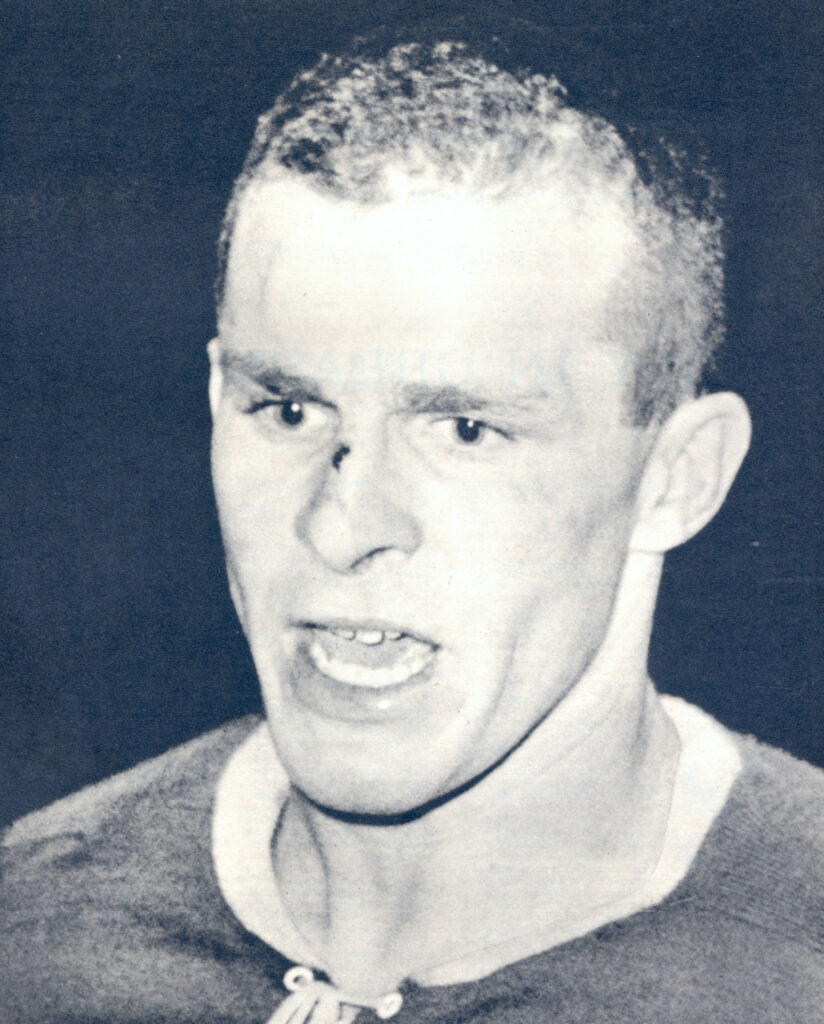
Just one year out of junior hockey, Leafs’ Carl Brewer is going to be right up there with Ted Lindsay and Lou Fontinato if he keeps on the way he’s going.
In the National Hockey league, where the genuine roughnecks have been abdicating in favor of the loud-mouthed collectors of misconduct penalties, there is at least one rule flouter dedicated to restoration of the old order.
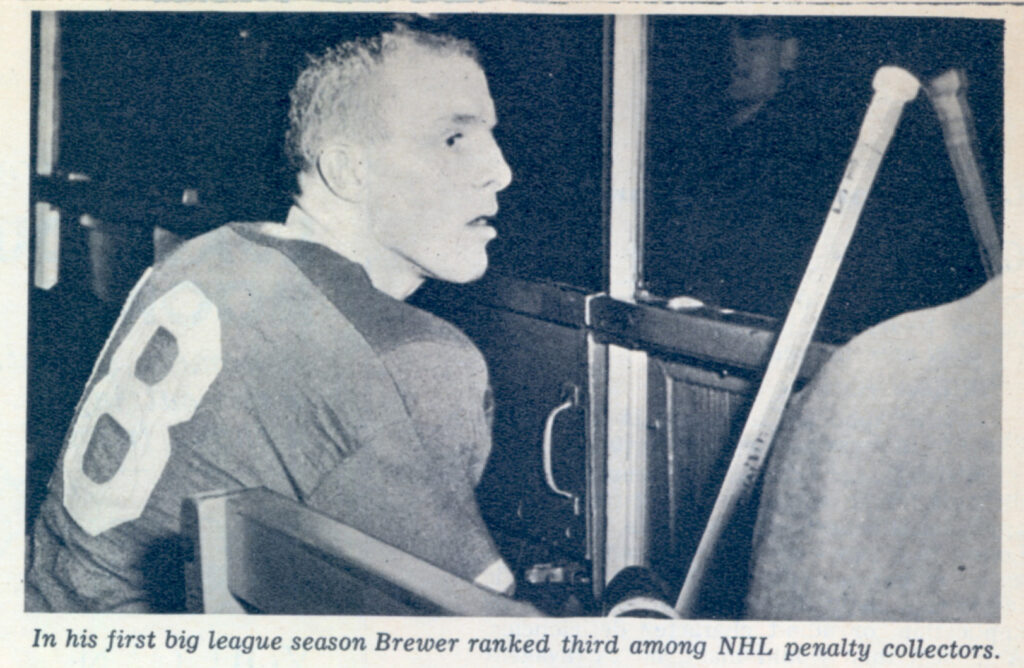
He is Carl Brewer, a stocky, brash, 21-year-old native Torontonian who, while still young enough to have played junior hockey last season, compiled 125 minutes in penalties with the Maple Leafs. This season he may well surpass that figure. In the first month of the campaign he spent 35 minutes in exile and was the league’s most penalized player.
In 1958-59 he ranked third among the badmen. On top of the list was Chicago’s Ted Lindsay, a chronic referee baiter whose loosely hinged mouth is the cause of many of his banishments.
In second place was New York‘s Lou Fontinato, whose reputation as a villain was considerably dimmed when he disobeyed Charles Dickens’ dictum to let sleeping dogs lie, and carelessly caressed Gordie Howe. The usually docile Detroit winger responded by shattering Fontinato’s nose with one well-aimed blow.
So far no National Hockey league rival has tampered with Brewer’s physiognomy, but there have been veiled threats from the opposition benches.
“Brewer isn‘t tough enough to get away with his rough-house tactics for long,” said Boston’s Leo LaBine. “Somebody is bound to take care of him.”
Between frequent trips to the penalty box, the irascible Brewer has been playing enough sound and spectacular hockey to be hailed as one of the greatest defensive finds of the decade. Last spring he took runner-up honors to Montreal’s Ralph Backstrom in sportswriters’ voting for the Calder Cup, awarded annually to the league’s outstanding rookie. This year, some say, he’ll be a strong candidate for the all-star team.
As formidable as a pocket battleship, Brewer packs 180 pounds on a solid five-foot-10 frame, and operates behind the blueline as though he owns all navigation rights.
Opponents get the idea he’d be a tough man to tangle with anywhere, but that impression is tempered by flashes of friendliness in his dark blue eyes—just enough to put them off guard.
Carl Brewer’s features might have been chipped out of granite. There’s a determined tilt to his jaw. His wide forehead is topped by closely cropped hair, typical of today’s young men. A long vertical scar creases the left of his forehead—a souvenir of his junior days, representing retaliation by an opponent who didn’t believe that a Brewer elbow belonged in his right ear. Small scars in his eyebrows and under his chin are the results of nasty stick nicks.
“Brewer is a fine young hockey player,” said King Clancy, assistant manager of the Toronto Maple Leafs and a former all-star defenceman. “Believe me, he’s up there with the top defencemen right now and he’s only21. He blocks well. He throws as stiff a bodycheck as anybody. And he’s versatile. If he didn’t play defence he’d make a fine centre.” An avuncular smile spread over Clancy’s face. “Sure, the kid gets a lot of penalties. He’s bound to because he plays all out.”
Rival coaches concede that Brewer is in the league to stay. “That little monkey is in our hair all the time,” said Milt Schmidt of the Boston Bruins, echoing the sentiments of Rudy Pilous of the Chicago Black Hawks who said: “He’s murder. A real hard checker who never lets up.”
Another view came from Maurice Richard of the Canadiens who has eluded enough defencemen in 17 years to set more scoring records than any other man in hockey history. “Brewer hasn’t been too tough against our club,” said the Rocket, “but he has the ear-marks of a good hockey player. Whether he becomes as good as some folks are predicting will depend on how hard he works.”
Brewer does work hard and any mistake she makes are more a reflection of inexperience than a mark of inability.
Coach Punch Imlach recalled one game against the Canadiens in which Brewer trapped a wayward shot and, instead of carrying the puck quickly beyond the Toronto blueline into the centre ice zone, decided unwisely to display a little fancy stickhandling. Suddenly, off guard for a fleeting second, he lost the puck to Henri Richard who flipped it to Marcel Bonin. Bonin sped goal ward unmolested and scored.
On the Toronto bench, Imlach fumed like Mount Etna. “Haven’t you learned yet, you gotta get the puck out?” he shouted. This, he later admitted ruefully, was a mistake. “I should have held my tongue and spoken to Brewer afterward,” he confessed. “The kid, boiling mad, charged Henri Richard of the Canadiens soon afterward, dumping him like a sack of wet laundry and, of course, getting a penalty for his pains.”
Brewer’s preponderance of minor penalties-he had only one major last season-proves that, unlike Lou Fontinato, he doesn’t go out of his way to engage in fisticuffs. And, unlike hard-skating, hard-jawing Ted Lindsay, he has never hurled a word of dubious propriety into the sensitive ears of a referee. Rather, he is inclined to charge like a bull elephant when he should be checking.
Brewer didn’t incur the first misconduct penalty of his professional career until shortly after the 1959-60 season got underway. The Maple Leafs were playing the Chicago Black Hawks in the Gardens, and he was behind the Toronto blueline with Bobby Baun.
“Baun set Bobby Hull up for a check,” Brewer recalled, “forcing him to swerve toward me. I thought I nailed him with a fair bodycheck but Eddie Powers must’ve thought I charged. Anyway, he blasted his whistle and waved me off. I never uttered a word. Not a word. But I was so darn mad I rapped my stick on the ice. That was enough for Powers. He said, ‘O.K., Brewer, you can sit out 10minutes longer.’
“I don’t like getting misconducts,” Brewer went on, “because they come with $25 price tags. Later in the game I heard some of the Black Hawks swearing and they got away with it. I think slapping a stick on the ice isn’t nearly as grievous as the use of bad language directed at an official.”
Imlach has taken no steps to curb Brewer’s penchant for penalties.
“Brewer is crafty and rough, and he has a mean streak in him,” Imlach said. “I expect he’ll always have a high penalty record but, on the credit side of the ledger, he makes opponents aware of him. They’re usually on edge, looking for a quick elbow or a fast hip, and that gives my man a slight advantage.
“I knew that Brewer had arrived as a National leaguer in. the playoffs when, every time he carried the puck past the Canadiens’ bench, they’d shout to their mates on the ice, ‘Get that guy.’ Players don’t waste talk like that on rookies.”
Perhaps the Leafs have needed a player of Brewer’s ilk to restore their fighting qualities. Toronto hasn’t won the Stanley Cup since 1951, when Gus Mortson, a hard-hitting defenceman not much bigger than Brewer, led the league in penalties for the second time in his career. In 1947,1948 and 1949 the Leafs won three straight Stanley Cups, and in each of those happy seasons they produced the National Hockey league’s most penalized player—first Mortson, then Bill Barilko, followed by Wild Bill Ezinicki.
In the 1930’s Toronto had flamboyant Red Hornet, a stick-swinging, fist-flailing tornado on ice, who led the league in penalties for eight consecutive seasons from 1932-33 to 1939-40.
Although a healthy specimen, muscular, brawny and youthful, Brewer finds that big league hockey, especially the long train trips, exacts a heavy physical toll. To combat fatigue and conserve his strength, he goes home immediately after practices in Maple Leaf Gardens and tries to sleep for an hour.
On the day of a game, he’ll sleep for two hours after his mid-afternoon steak, letting tension drain from his body. Every night he spends nine to10 hours in bed, but sometimes when the pressure is tying knots in his stomach muscles, sleep eludes him.
Brewer lives at home in Toronto’s east end with his parents and a younger brother, Jack. Married and in homes of their own are an elder brother, Frank, and a sister, Shirley.
Born in Toronto on Oct. 21, 1938, Brewer inherited his athletic ability. His father. Carl Brewer, Sr., was a star soccer player and a softball pitcher. An uncle, Willie Brewer, also was a noted athlete around Toronto some 20 years ago.
Mrs. Brewer has been an avid hockey fan for years, but she seldom sees Carl as a performer except on television. “I hated to watch those young fellows being hit so hard,” she explained. “Now that Carl is doing a lot of the hitting and taking a few jolts himself, I’m afraid I couldn’t stand it.”
Like most of his young teammates, Brewer is studiously bent. His ambition is to become a teacher, specializing in foreign languages.
Dead tired at the end of last season—his legs, he said, were like lead—Brewer recuperated in Nassau for two weeks with teammates Dickie Duff and Frank Mahovlich. Then, after the trip, he spent six gruelling weeks with a private tutor in Toronto wrestling with the intricacies of Latin grammar, one of his weak subjects when he was attending Riverdale collegiate and perhaps devoting too much time to the neighborhood rink.
Six weeks’ cramming paid off. Brewer passed a supplementary Latin examination with honors to get his senior matriculation. Armed with this certificate of scholastic standing, he enrolled in McMaster university’s summer school and, for another six weeks, studied American history and Spanish, getting credits towards a bachelor of arts degree. Already he has a smattering of German and French.
Between study periods, Brewer found time to play a few games of baseball with the Maple Leafs all-stars, a group of hockey players who donate proceeds from their games -to charitable organizations. A versatile athlete, he had previously played high-school football and distinguished himself as a dashing shortstop with a .300-plus batting average in the Toronto playground leagues. After a long, hard look at him the Cleveland Indians once arranged a trial for him with a Class D farm club at Batavia, N.Y., but with his heart set on hockey, he declined the invitation.
As a hockey player, young Brewer is trying constantly to improve himself by absorbing miscellaneous intelligence about rival players. With his defence partner, Bobby Baun, he discusses the idiosyncracies of troublesome opponents until each knows exactly what reaction to expect in almost any situation. Brewer has admitted, though. that while athletes develop peculiar patterns of play, a cagey old pro can cross up a rookie and make him look very bad indeed.
As a youngster Brewer wasn’t considered too seriously as a professional prospect. When he was playing in the midget classification at the age of l6, he saw others, because they were bigger than he, promoted to Junior B.
“I knew in my heart I was as good as they were, perhaps better,”- he said, “and Cliff Cooper, a scout and overseer for the Marlboros, gave me plenty of encouragement.”
Perseverance and practice helped Carl to perfect his play. Exercise and consumption of vast quantities of food helped him to develop his physique. Finally he moved up to the Weston Dukes in Junior B, then to the Marlboros in Junior A. He was with them in 1956 when they won the Canadian junior championship. The following season he was acclaimed as the most valuable player on the team.
In the fall of 1958 Brewer agreed to a five-day trial as a professional, something elastic rules permit hockey players to do without endangering their amateur standing. Brewer played one game for the Rochester Americans, then reported to the Maple Leafs. His hard-driving style, his fearlessness, his tenaciousness all so impressed the Leafs that they offered him a contract on Saturday, Oct. 18, the night he was to play his fifth lend-lease game.
Brewer held out for four days, missing a Sunday-night game against the Red Wings in Detroit while he haggled over terms. He wanted a two-year contract under which he would draw a major league salary even if sent to the minors. Finally, for something like $25,000 for two seasons, he capitulated. It is understood he agreed to a minor league clause for 1959-60 after Imlach explained: “A kid, if he can’t make the grade right away, is better at Rochester, playing and learning than he is sitting on the Toronto bench, gathering splinters in his pants.”
Brewer’s fourth game with the Leafs, his last before signing, was against the Boston Bruins in Toronto. It turned out to be an eventful night. He scored his first NHL goal while still technically an amateur, giving the Leafs a second-period lead. In the third period came an encounter in which Bronco Horvath suffered a fractured jaw.
Boston manager Lynn Patrick charged the Leafs were using “sledgehammer elbow pads” with thin foam rubber over a fibre cap and that Brewer had elbowed Horvath. Leafs were using the dangerous pads, which have since been replaced by better protective equipment; that much was established. But Brewer insisted he didn’t use an elbow on Horvath, just his shoulder.
“Horvath realized that,” he contended. “He told me so. It was just an unfortunate accident. He got his last year. Maybe I’ll get mine this year. I’m not afraid. You’ve got to expect those things in hockey.”
He‘s a hard kid, that Brewer, generously endowed with ability and a devil-may-care approach to the game.
He’ll go far, most experts agree.