|
| 1953 ad for Anaconda Copper |
 |
$5.00
Size- 21 x 13 ½
Condition- This ad is in excellent condition but
is on two separate pages that will need to be matted together. |
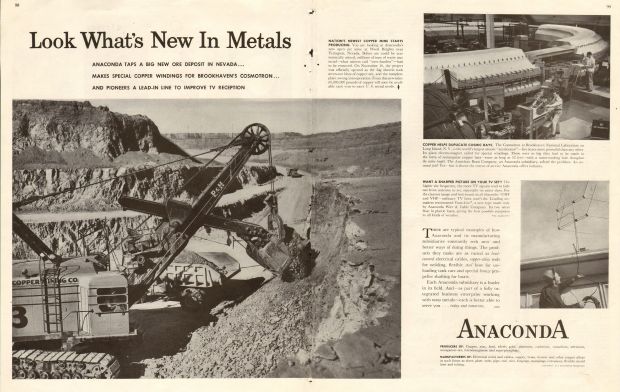
1953 2-page ad for Anaconda Copper Company
Title- "Look What's New In Metals"
History- (from Wikipedia) (edited from Wikipedia) The Anaconda Copper Mining Company, known as the Amalgamated Copper Company between 1899 to 1915, was an American mining company headquartered in Butte, Montana. It was one of the largest trusts of the early 20th century and one of the largest mining companies in the world for much of the 20th century.
In 1883, Marcus Daly, a self-taught miner, engineer and geologist, built a smelter at Anaconda, Montana, and a company town to support the workers. He connected his smelter to Butte by his Butte, Anaconda and Pacific Railway. Butte became one of the most prosperous cities in the US, often called "the Richest Hill on Earth." From 1892 through 1903, the Anaconda mine itself was the largest copper-producing mine in the world. It produced more than $300 billion worth of metal in its lifetime.
|
|
| 1936 ad for Alcoa |
 |
$7.00
Size- 10 ½ x 13 ¾
Condition- Excellent |
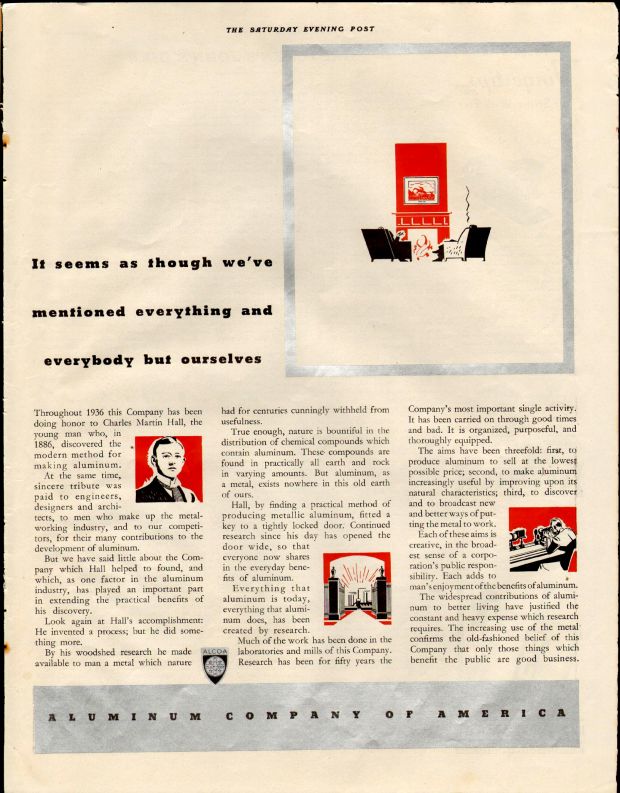
1936 large color magazine ad for ALCOA
Title- "It seems as though we’ve mentioned everything and everybody but ourselves"- the ad shows a cartoon in a silver frame and talks about the history of aluminum production.
History- (from Wikipedia) In 1886, Charles Martin Hall discovered the process of smelting aluminum, almost simultaneously with Paul Héroult in France. He realized that by passing an electrical current through a bath of cryolite and aluminum oxide, the then semi-rare metal aluminum remained as a byproduct. This discovery, now called the Hall-Héroult process, is still the only process used to make aluminum. Hall’s aluminum manufacturing company operated under various names and in various places but became The Aluminum Company of America on January 1, 1907. The acronym "Alcoa" was coined in 1910 and, in 1999, was adopted as the official corporate name.
|
|
1957 ad for Allis-Chambers, Saint
Lawrence Seaway Project |
 |
$10.00
Size- 20 by 13 ½
Condition- This ad is in excellent condition but
is on two separate pages that will need to be matted together. |
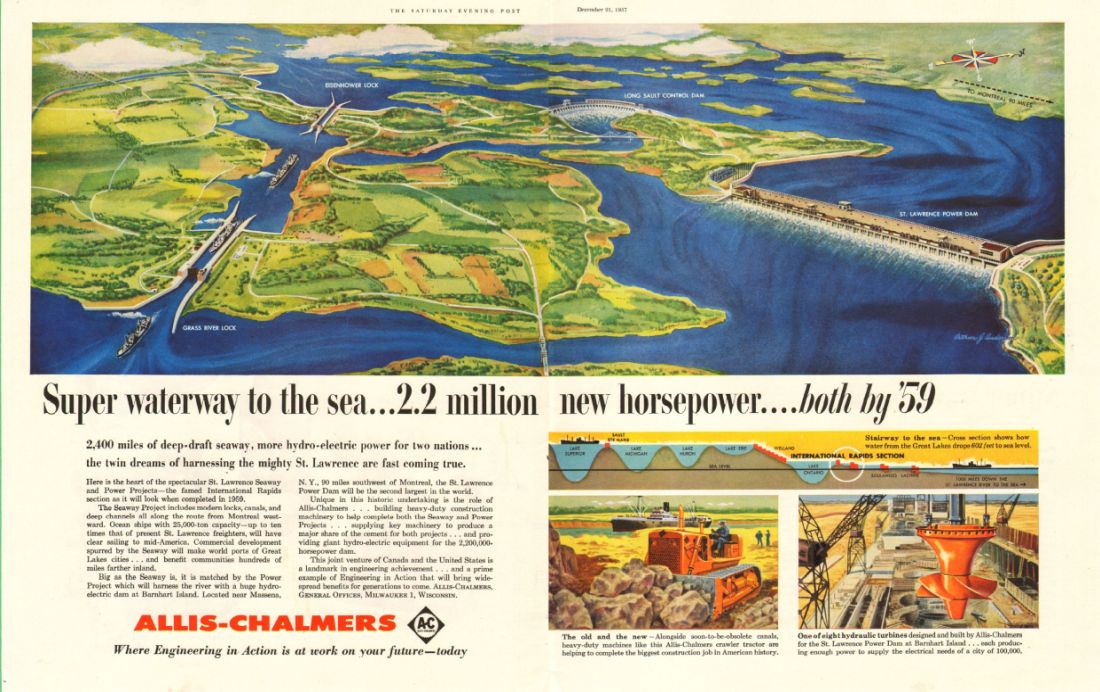
1957 2-page ad for Allis-Chambers,
Saint Lawrence Seaway
Title- "Super waterway to the sea"- the ad shows a drawing of what the Saint Lawrence Seaway will look like when it is completed in 1959.
History- (from Wikipedia) The Saint Lawrence Seaway opened in 1959 and cost $470-million Canadian dollars, $336.2 million of which was paid by the Canadian government. It was officially opened in 1959 by Queen Elizabeth II and President Dwight Eisenhower.
Also part of the Seaway project was the Moses-Saunders Power Dam on the Saint Lawrence River straddling the border between the United States and Canada. The dam supplies water to two adjacent hydroelectric power generating stationsone in the US and one in Canada. Constructed between 1954 and 1958, the dam created Lake St. Lawrence.
About 22,000 workers were employed at one time or another on the seaway project which provides a 2,300-mile-long superhighway to the sea for ocean freighters.
|
|
1947 full page ad
for Caterpillar |
 |
$5.00
Size- 10 ¼ x 13 ¼
Condition- Excellent |
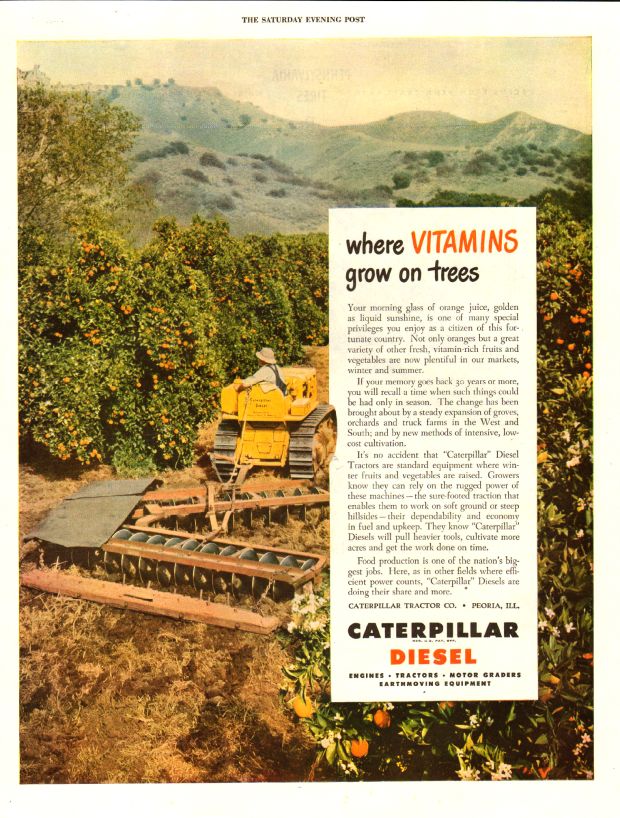
Large 1947 full page ad for Caterpillar
Title- "Where vitamins grow on trees" - the ad shows a Caterpillar tractor working in an orange grove.
History- (edited from Wikipedia) Caterpillar Inc. is the world's largest manufacturer of construction equipment. Two competing companies, C. L. Best and Holt Caterpillar, had some success during World War I but struggled thereafter until the Federal Aid Highway Act of 1921 kickstarted a $1 billion federal highway building program. Both companies refocused towards building road-construction equipment. The two companies merged in 1925 to form the Caterpillar Tractor Co. During World War II, Caterpillar products found fame with the Seabees, construction battalions of the United States Navy, which built airfields and other facilities in the Pacific Theater of Operations.
|
1953 full page ad
for Caterpillar |
 |
$5.00
Size- 10 ¼ x 13 ¼
Condition- Excellent |
Large 1953 full page ad for Caterpillar
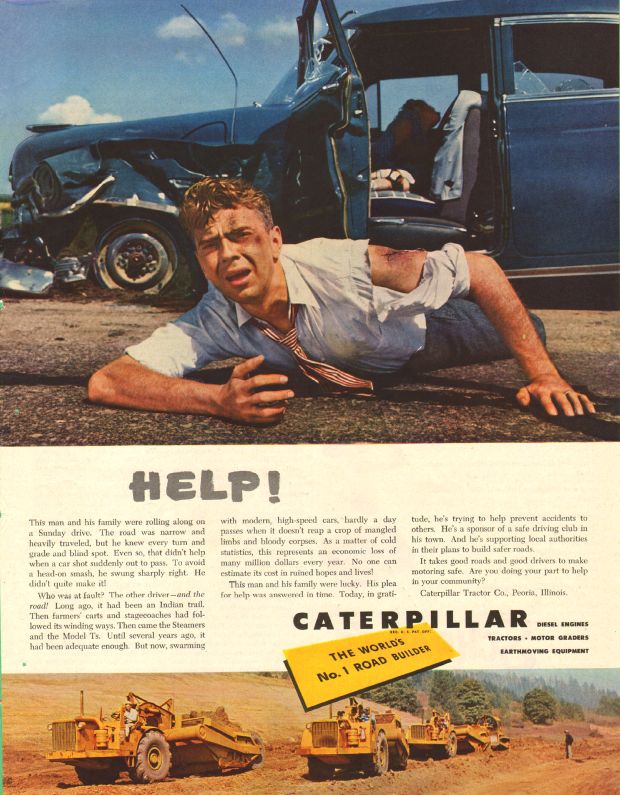
Title- "HELP!"- the ad features a photo of an injured young man crawling away from his wrecked car. A scare tactic ad from the fine folks at Caterpillar. According to them with Americans driving on unimproved highways "hardly a day passes when it doesn't reap a crop of mangled limbs and bloody corpses."
Calling themselves the world's number one road builder Caterpillar tells us it takes good roads and good drivers to make motoring safe.
|
1954 full page ad
for Caterpillar |
 |
$4.00
Size- 10 ½ x 13 ¼
Condition- very good with some discoloration on the left side and a light stain on the right edge. |
Large 1954 full page ad for Caterpillar
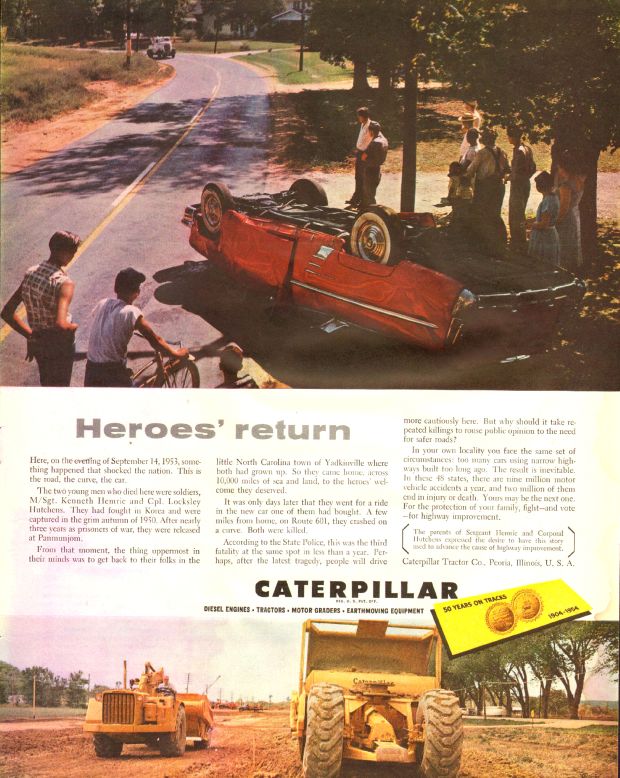
Title- "Heroes’ Return"- the ad features a photo of a car accident in which two young men were killed.
This distasteful ad tells the story of two soldiers who were killed in a car accident in 1953 in North Carolina. The ad explains that there are "too many cars using narrow highways built too long ago" and it encourages readers to fight and vote for improved highways. Highways that, no doubt, would be built using Caterpillar equipment.
|
|
1953 full page ad
for Cutler-Hammer Motor Controls |
 |
$5.00
Size- 10 x 13 ½
Condition- excellent |
Large 1953 full page ad for Cutler Hammer Motor Controls
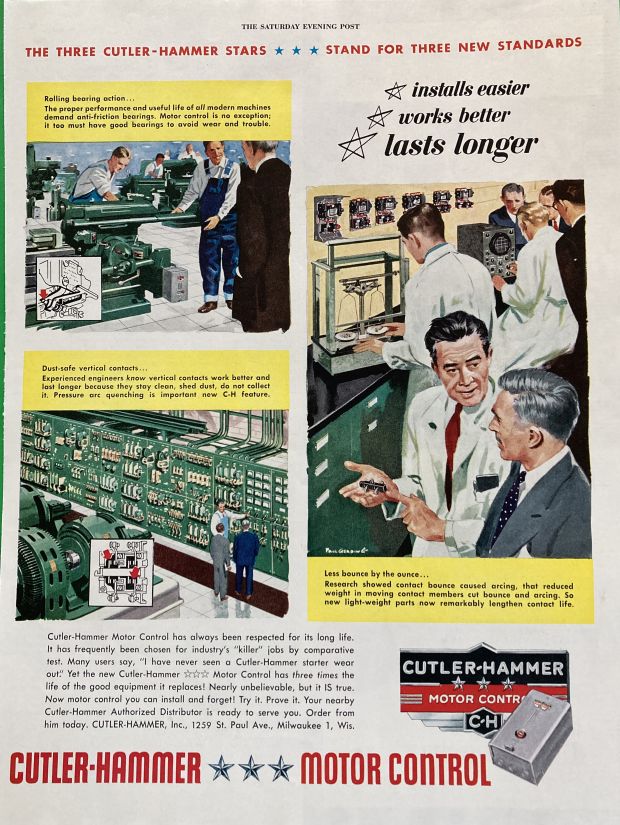
Title- "The three Cutler-Hammer stars stand for three new standards- Installs Easier, -Works Better, Lasts Longer"- this ad shows Cutler-Hammer products at work.
History- Harry Henderson Cutler and Edward West Hammer incorporated the Cutler-Hammer Manufacturing Co. in 1893, specializing in electric starters, speed regulators and field rheostats. They also developed the first automatic motor starter (patented by Cutler in 1900) laying the foundation for the modern motor control industry, and in 1901 the company designed the control equipment for the Panama Canal. By the 1930s, engineers at Cutler-Hammer had obtained 28 patents for the use of vacuum tubes to control heavy currents. Cutler-Hammer is now part of Eaton, a global power management company.
|
|
1950 full page ad
for Detroit Diesel |
 |
$5.00
Size- 10 ½ x 13 ½
Condition- excellent |
Large 1950 full page ad for Detroit Diesel
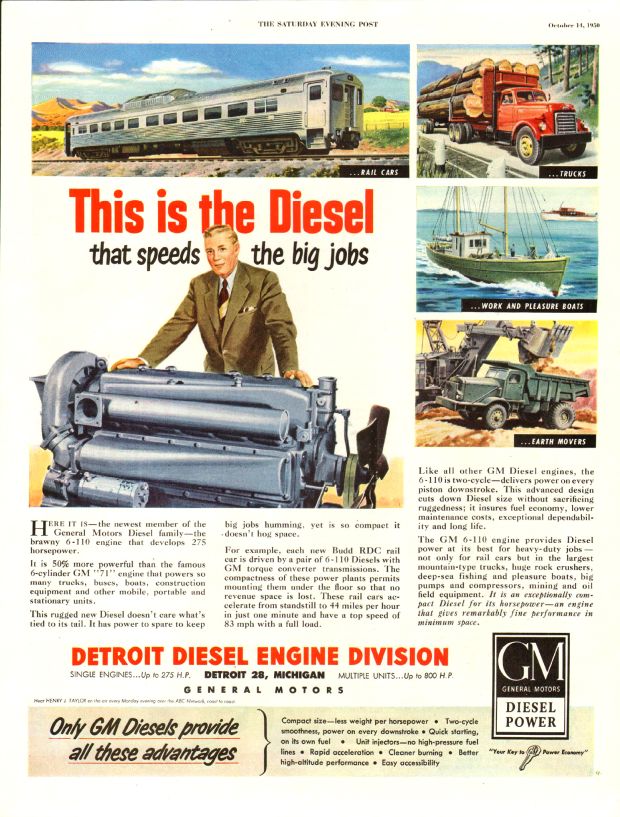
Title- "This is the Diesel that speeds the big jobs!"- this ad shows several different types of vehicles that use Detroit Diesel engines.
History- (edited from Wikipedia) - In 1938 General Motors began diesel engine manufacturing in Detroit under the Detroit Diesel Engine Division. During World War II tanks, landing craft, road building equipment and standby generators used the company’s compact, lightweight, two-cycle engines. In 1943, Detroit Diesel employed 4,300 people who produced 57,892 engines. By the 1950s wide use of GM's Detroit Diesel engines in military applications aided their acceptance in commercial applications.
|
|
1956 full page ad
for Dofasco |
 |
$6.00
Size- 10 ¼ x 14 ½
Condition- excellent |
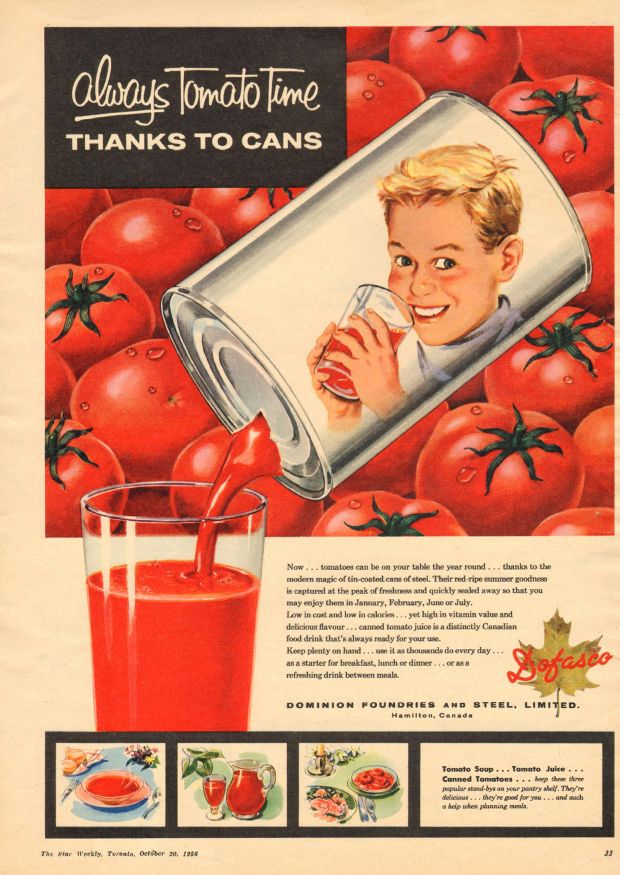
Large 1956 full page ad for Dofasco
Title- "Always tomato time thanks to cans"- the ad shows can in front of a bunch of tomatos.
History- (edited from Wikipedia) Dofasco was incorporated in Hamilton, Ontario as Dominion Steel Castings Company Limited in 1912, becoming Dominion Foundries and Steel Company in 1917. Its longtime nickname "Dofasco" was adopted as its legal name in 1980.
In 1954 the company introduced a method of steel production known as basic oxygen steelmaking (BOS), that allowed the same quantity of steel to be manufactured in one-twelfth the time of other methods.
|
|
1947 full page ad
for Dominion Rubber |
 |
$6.00
Size- 10 ¾ x 14 ¾
Condition- Excellent condition with a couple of small tears on the right edge. |
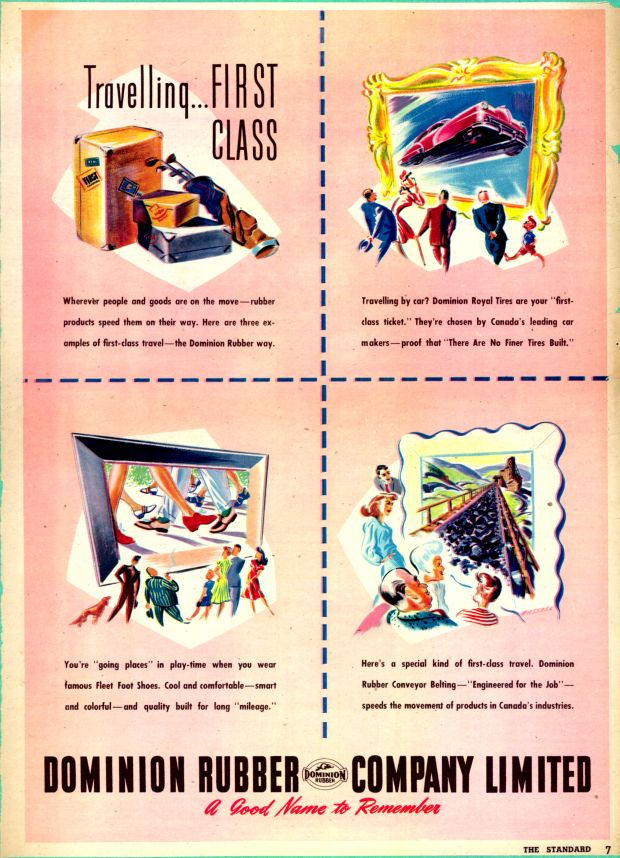
Large 1947 full page ad for Dominion Rubber
Title- "Travelling...First Class"- this ad shows different examples of the uses of rubber.
History- (edited from Wikipedia) Dominion Rubber started operations as Brown, Hibbard and Bourne, in 1854. After a variety of names and frequent mergers the company became the Dominion Rubber Company Limited in 1926. It produced footwear under a variety of brand names, coated upholstery fabrics, mechanical parts, industrial chemicals and vehicle tires. In 1966, after four decades as Dominion, the company was renamed Uniroyal Ltd.
|
|
1957 full page ad
for Fairbanks-Morse |
 |
$7.00
Size- 10 ½ x 13 ½
Condition- Excellent |
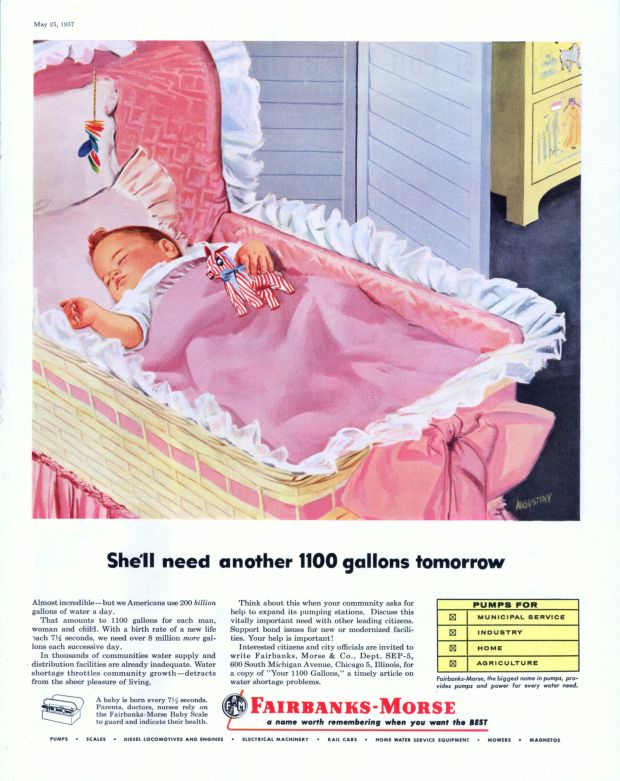
Large 1957 full page ad for Fairbanks-Morse
art by Edward Augustiny
Title- "She'll need another 1100 gallons tomorrow"- the ad shows a sleeping baby and points out that on average each American uses 1100 gallons of water every day. It encourages readers to support initiatives to upgrade water supply facilities. The ad also offers readers a chance to send for a copy of "Your 1100 Gallons," which it describes as "a timely article on water shortage problems."
History- (edited from Wikipedia) Fairbanks, Morse and Company was an American manufacturing company in the late 19th and early 20th century. Originally a weighing scale manufacturer, it later diversified into pumps, engines, windmills, coffee grinders, radios, farm tractors, feed mills, locomotives, and industrial supplies until it was purchased by Penn Texas in 1958.
|
|
1943 full page ad
for Goodyear Rubber |
 |
$7.00
Size- 10 ½ x 13 ½
Condition- Excellent |
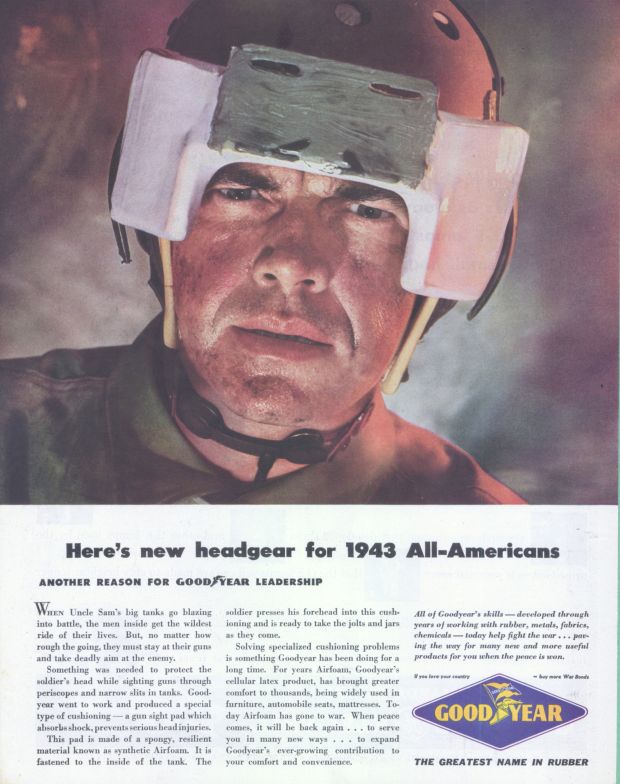
Large 1943 full page ad for Goodyear
Title- "Here's new headgear for 1943 All-Americans"- the ad shows the member of an American tank crew wearing a new helmet developed by Goodyear.
History- (edited from Wikipedia) The first Goodyear factory opened in Akron, Ohio, in 1898. The 13 original employees manufactured bicycle and carriage tires, rubber horseshoe pads, and poker chips. The company grew with the advent of the automobile.
In 1901 the company provided Henry Ford with racing tires and in 1903, they were granted a patent for the first tubeless automobile tire. By 1908 Ford was outfitting his Model T with Goodyear tires. In 1909 Goodyear manufactured its first aircraft tire. By 1926 Goodyear was the largest rubber company in the world. During the next 60 years Goodyear grew to become a multinational corporation with multibillion-dollar earnings.
|
|
1953 full page ad
for Hyatt Bearings |
 |
$4.00
Size- 10 x 13 ¼
Condition- Excellent |
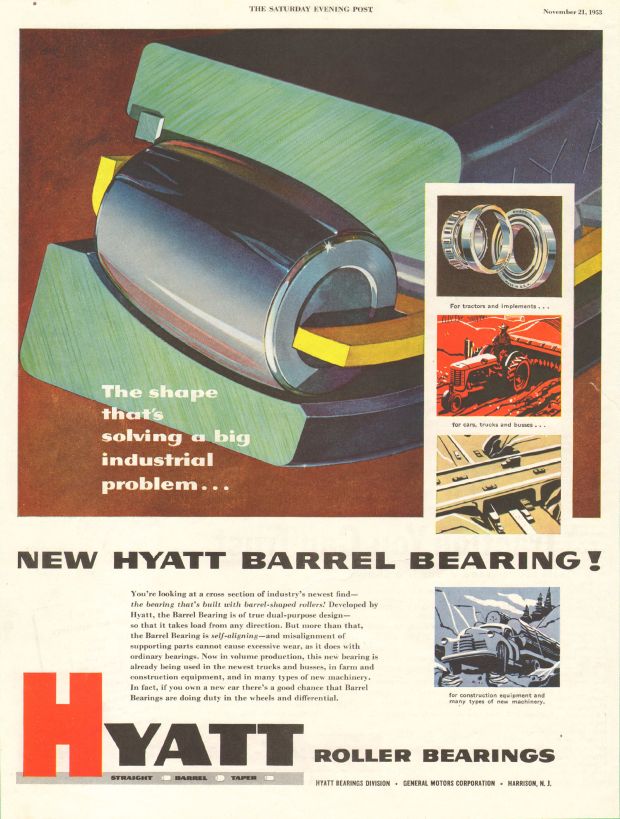
Large 1953 full page ad for Hyatt Barrel Bearings
Title- "The shape that's solving a big industrial problem...New Hyatt Barrel Bearing!"
|
|
1950 full page ad
for Honeywell Controls |
 |
$4.00
Size- 10 ¼ x 13 ½
Condition- Excellent condition |
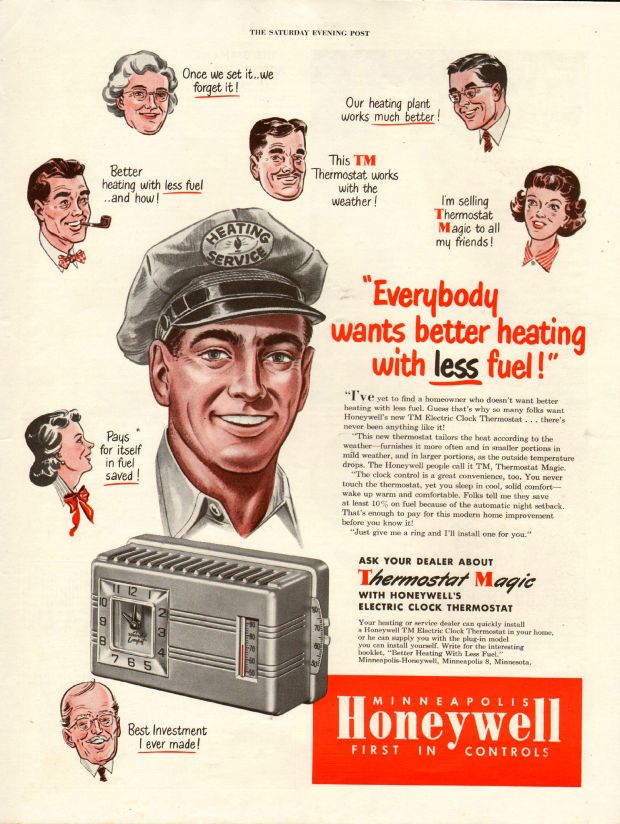
1950 full page ad for Honeywell Controls
Title- Better heating with less fuel
History- (edited from Wikipedia) In the early 1900s Mark Honeywell developed a hot water heating system, and his business became Honeywell Heating Specialties Company. Honeywell's main competitor was W.R. Sweatt and his Minneapolis Heat Regulator Company. The two companies had patents which blocked each other from further growth. They merged to form the Minneapolis-Honeywell Regulator Company, with Sweatt as chairman and Honeywell as president. Honeywell now has a global workforce of about 130,000, and is headquartered in Morris Plains, New Jersey.
|
| 1953 2-page ad for Honeywell Controls |
 |
$7.00
Size- 21 x 13 ¼
Condition- excellent condition but is made up of two separate pages and would need to be matted to display properly. It has several stitch holes near the middle seams of both pages |
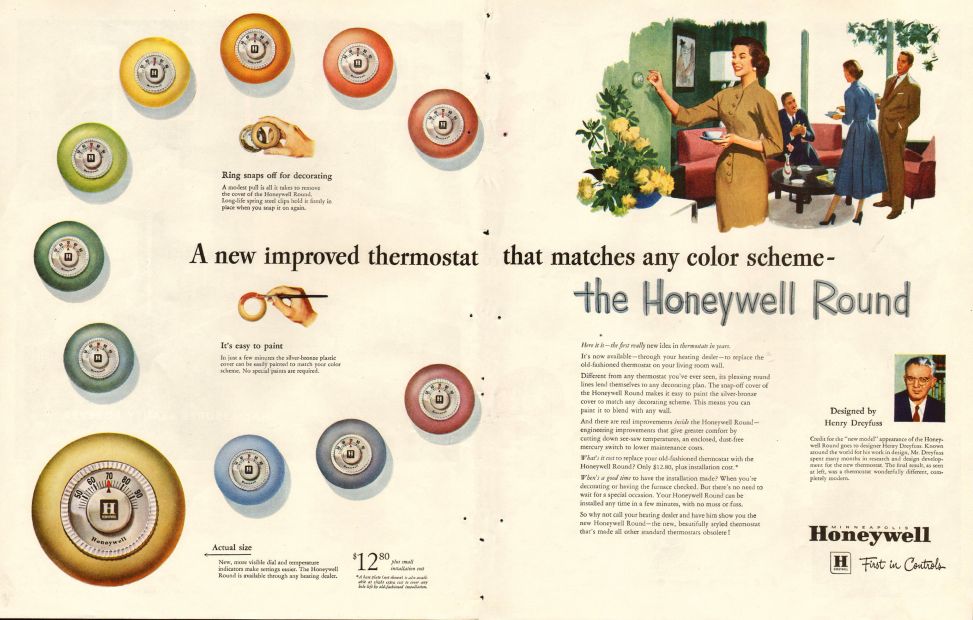
1953 large 2-page color magazine ad for Honeywell Thermostats
Title- "A new improved thermostat that matches any color scheme- the Honeywell Round"- the ad shows a variety of round thermostats on one page and a household scene on the second page.
History- (from Wikipedia) In 1953, Honeywell introduced their most famous product, the T-86 Round thermostat, as seen in the accompanying ad.
|
| |
| Monsanto Plastics 1949 Ad |
 |
$7.00
Size- 10 ¼ x 13 ½
Condition- Very good, small stains and wear |
Monsanto Plastics 1949 Ad
Title- "Start the day happy with Monsanto Plastics"- the ad shows Metropolitan Opera star James Melton happily combing his hair with a Monsanto hair brush.
History- (from Wikipedia) Monsanto Company is an American multinational agricultural biotechnology corporation. It is a leading producer of the herbicide glyphosate, which it markets under the Roundup brand.
The company was founded in 1901 by John Francis Queeny, by the 1940s it was a leading manufacturer of plastics, including polystyrene and synthetic fibers. It remained one of the top 10 U.S. chemical companies until it divested most of its chemical businesses between 1997 and 2002.
|
|
| 1953 ad for Philadelphia Electric Company |
 |
$5.00
Size- 10 x 13 ½
Condition- Excellent |
1953 ad for Philadelphia Electric Company
Title- "A Brighter Future Dawns for You- A Great Philadelphia"- the ad shows the Philadelphia waterfront and extols the value of doing business in the city.
|
|
| 1958 ad for Portland Cement |
 |
$4.00
Size- 10 ½ x 13 ¼
Condition- Very good condition, tear in the bottom right edge. |
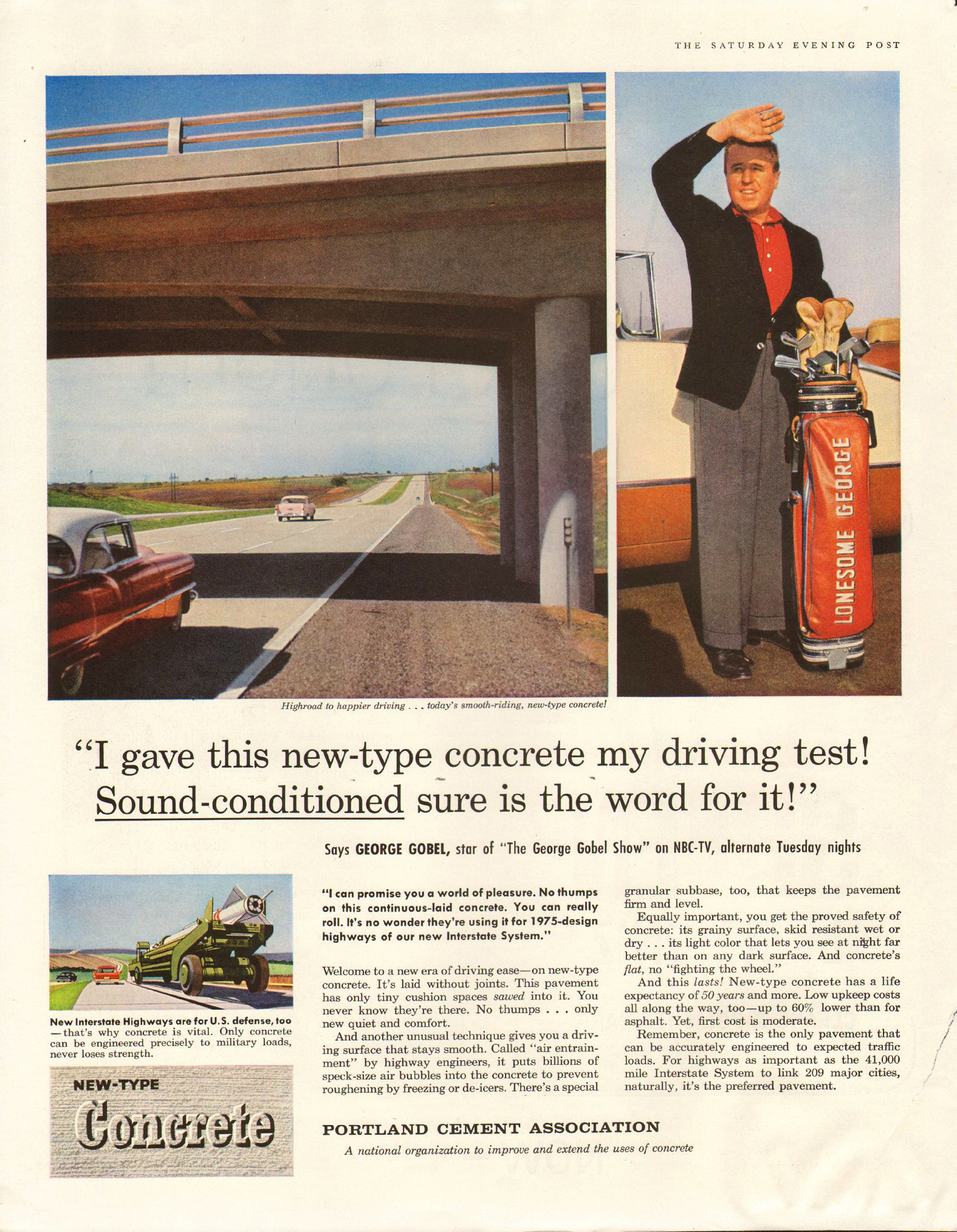
1958 ad for Portland Cement with George Gobel
Title- "I gave this new-type concrete my driving test! Sound-conditioned sure is the word for it!"- the ad shows TV star George Gobel standing next to a highway. George Gobel was an American comedian and actor. He was best known as the star of his own weekly NBC television show, The George Gobel Show, which ran from 1954 to 1960. His quiet, homespun style of humor was a huge success and the popular series made the crewcut Gobel one of the biggest comedy stars of the 1950s. In 1955, Gobel won an Emmy Award for "most outstanding new personality."
History- (from Wikipedia)Portland cement is the most common type of cement in general use around the world. Portland cement was developed from natural cements made in Britain beginning in the middle of the eighteenth century, and its name is derived from its similarity to Portland stone, a type of building stone that was quarried on the Isle of Portland in Dorset, England.
|
|
| 1947 ad for Timken Bearings |
 |
$6.00
Size- 10 ½ x 13 ½
Condition- Excellent |
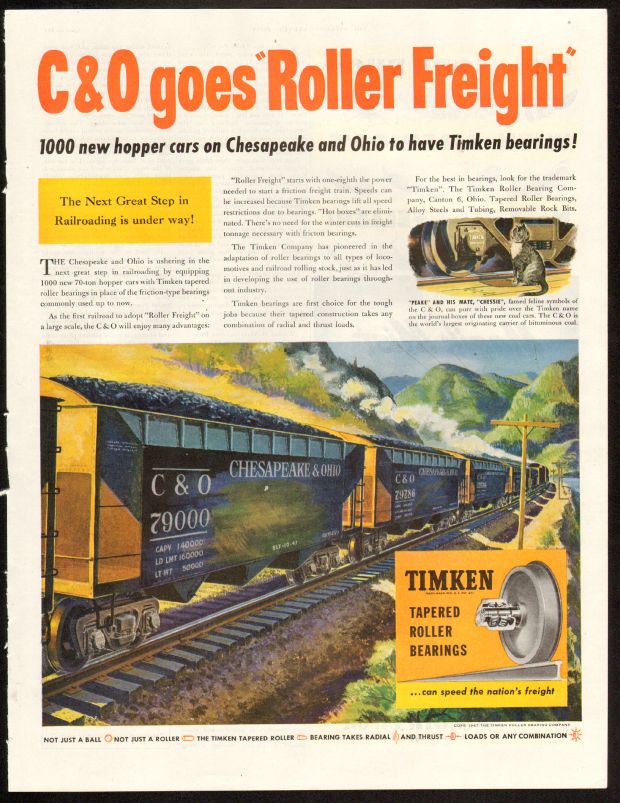
1947 full-page magazine ad for Timken Bearings
Title- "C&O goes Roller Freight."- C&O being the Chesapeake & Ohio Railroad that, apparently, had just equipped 1,000 70-ton hopper cars with Timken bearings."
History- The Timken Roller Bearing Axle Company was founded by Henry Timken in St. Louis, Missouri in 1899 In 1898 Timken had obtained a patent for the tapered roller bearing for which the company became known. It was this patent for tapered roller bearings that allowed his company to become successful. Timken significantly reduce friction on his bearings by using a "cup" and "cone" design incorporating tapered bearings which actually rolled. This reduced the load placed on the bearings by distributing the weight and load evenly across the cups, cones, and bearings. Ray Harroun, winner of the first Indianapolis 500, used Timken Bearings on his vehicle.
|
| 1953 ad for Timken Bearings |
 |
$5.00
Size- 10 ½ x 13 ½
Condition- Excellent, light staining. |
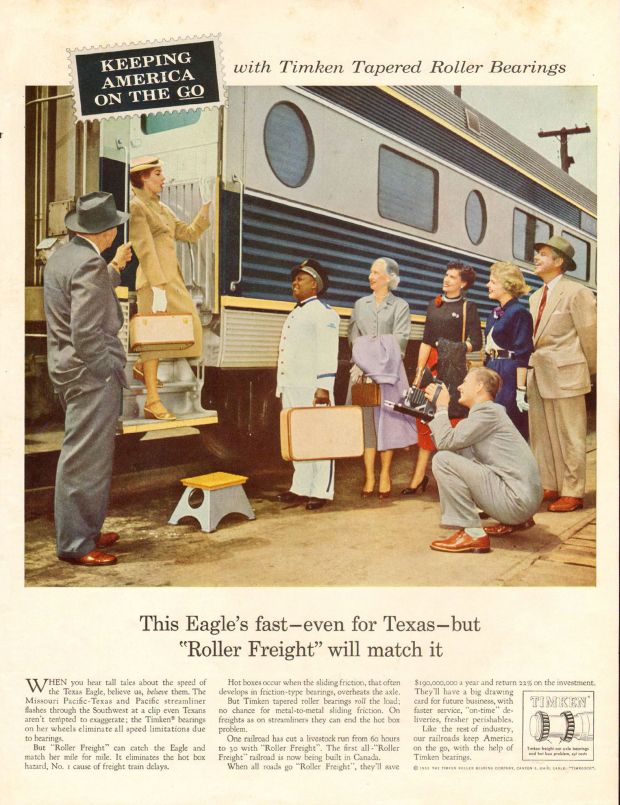
1953 full-page magazine ad for Timken Bearings
Title- "Keeping America on the go with Timken Tapered RollerBearings"
|
|
| 1953 ad for Union Carbide |
 |
$9.00
Size- 10 ¼ x 13 ¼
Condition- Excellent |
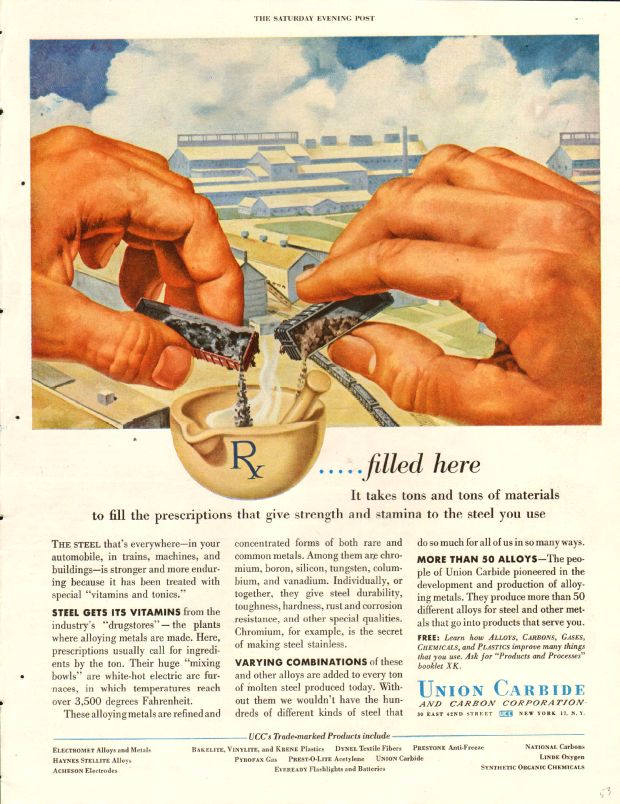
1953 full-page magazine ad for Union Carbide
Title- "Prescription filled here"- the ad shows a pair of god-like hands dumping the contents of two rail cars into a druggist’s mortar.
History- Founded in 1917 as the Union Carbide and Carbon Corporation the company's researchers developed an economical way to make ethylene from natural gas liquids, giving birth to the modern petrochemical industry. Before divesting them, the chemical giant owned consumer products Eveready and Energizer batteries, Glad bags and wraps, Simoniz car wax, and Prestone antifreeze.
It is probably best known for the Bhopal Disaster in 1984 when gas accidentally released from a company plant, resulted in 3,787 deaths and left an estimated 40,000 individuals permanently disabled, maimed, or suffering from serious illness. In order to pay off its debt, Carbide sold many of its most familiar brands such as Glad Trashbags and Eveready Batteries. Dow Chemical announced the purchase of Carbide in 1999.
|
| 1953 ad for Union Carbide |
 |
$7.00
Size- 10 ¼ x 13 ¼
Condition- Excellent |
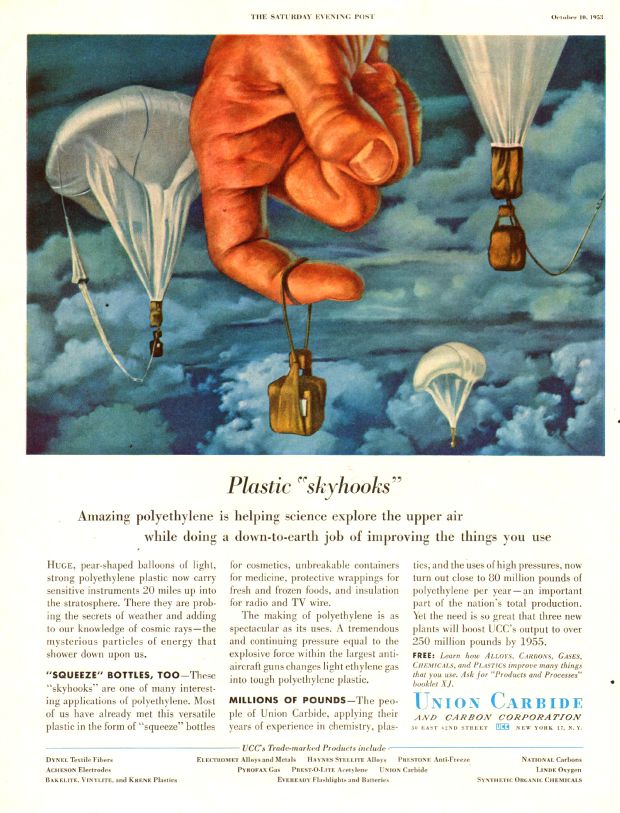
1953 full-page magazine ad for Union Carbide
Title- "Plastic Skyhooks"- the ad shows a giant hand holding equipment in the air while the ad copy proclaims the value of "amazing polyethylene."
|
| 1953 ad for Union Carbide |
 |
$7.00
Size- 10 ½ x 13 ½
Condition- Excellent |
1957 full-page magazine ad for Union Carbide
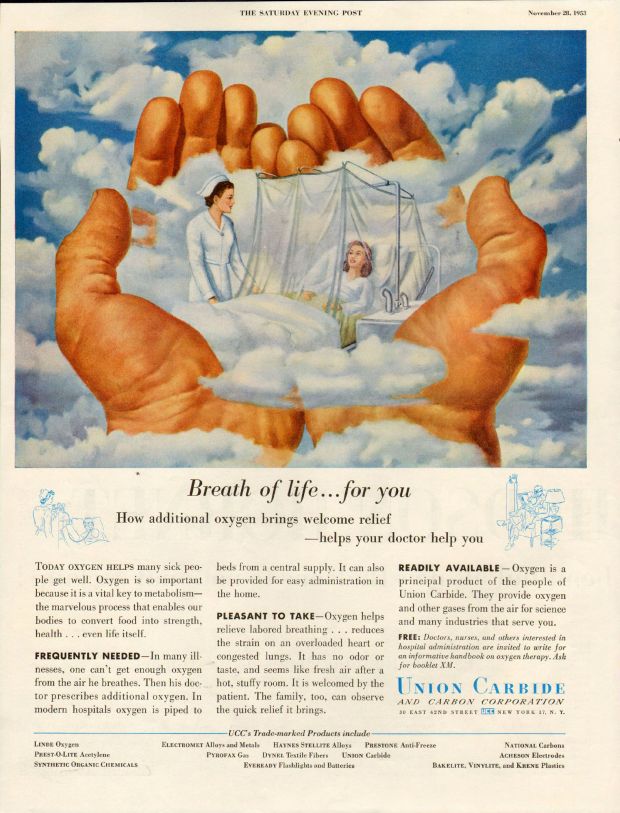
Title- "Breath of Life...for you"- the ad shows a pair of cupped, god-like hands holding a hospital patient in an oxygen tent up in the clouds"
|
|
1957 ad for Weyerhäuser Timber,
art by Bruce Bomberger |
 |
$7.00
Size- 10 ½ x 13 ½
Condition- Excellent |
1957 full-page magazine ad for Weyerhäuser
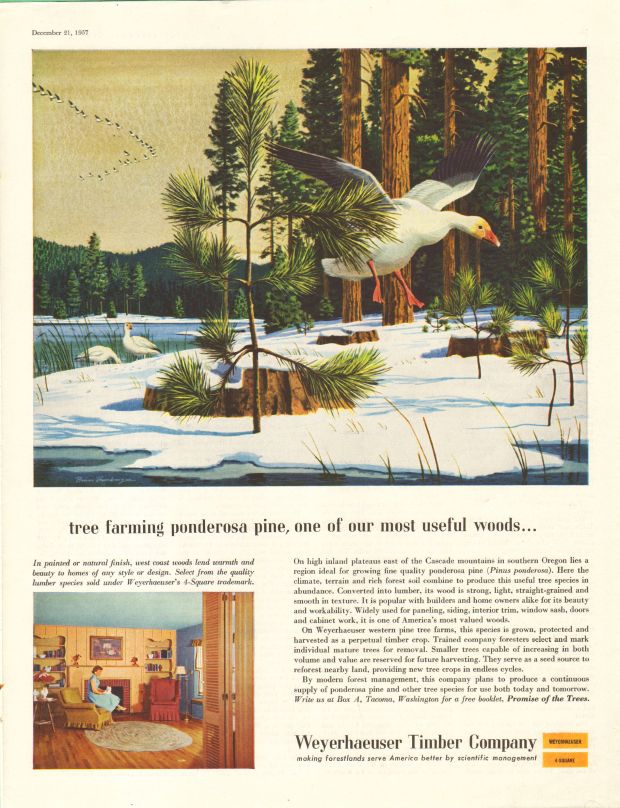
Title- "Tree farming ponderosa pine, one of our most useful woods!"- this ad shows a woodland scene painted by artist Bruce Bomberger. Bomberger began his painting career at age eight and sold his first major story illustration (at age 20) to Good Housekeeping. He soon developed into one of America's leading illustrators - a career he pursued for more than 25 years.
History- Weyerhäuser is an American timberland company which owns nearly 12,400,000 acres of timberlands in the U.S. and manages an additional 14,000,000 acres under long-term licenses in Canada. The company also manufactures wood products.
In 1904, after years of successful Mississippi River-based lumber and mill operations, Frederick Weyerhäuser moved west to fresh timber areas and founded the Weyerhäuser Timber Company. Weyerhäuser's pulp mill in Longview, WA, which began production in 1931, sustained the company financially during the Great Depression.
|
| 1958 ad for Weyerhäuser Timber, art by Stan Galli |
 |
$7.00
Size- 10 ½ x 13 ½
Condition- Excellent |
1958 full-page magazine ad for Weyerhäuser
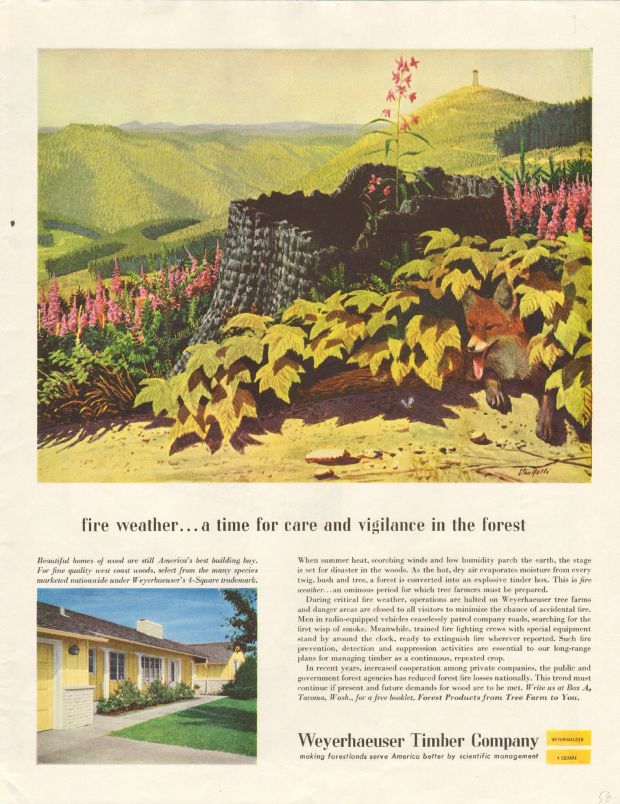
Title- "fire weather...a time for care and vigilance in the forest"- this ad shows a fox hiding in the shade while the ad copy describes how thge company takes extra care while working in the woods during dry periods. It is painted by artist Stan Galli.
(Information from the Norman Rockwell Museum website) Stan Galli (1912-2009) was a prolific illustrator whose work crossed many genres- magazine illustration, postage stamp design, travel posters, Navy training manuals, advertising posters, and landscape paintings of the Italian countryside.
From the 1950s through the 1960s, Galli's work appeared in many publications including The Saturday Evening Post, Ladies' Home Journal, and Reader's Digest. Beginning in 1952, he painted images of wildlife for Weyerhauser Timber advertisements. His images of foxes, ducks, bobcats, raccoons, deer, bear cubs, pheasant, and numerous other animals taking advantage of Weyerhauser's forestry policies helped to soften the image of the timber industry.
|
|
|