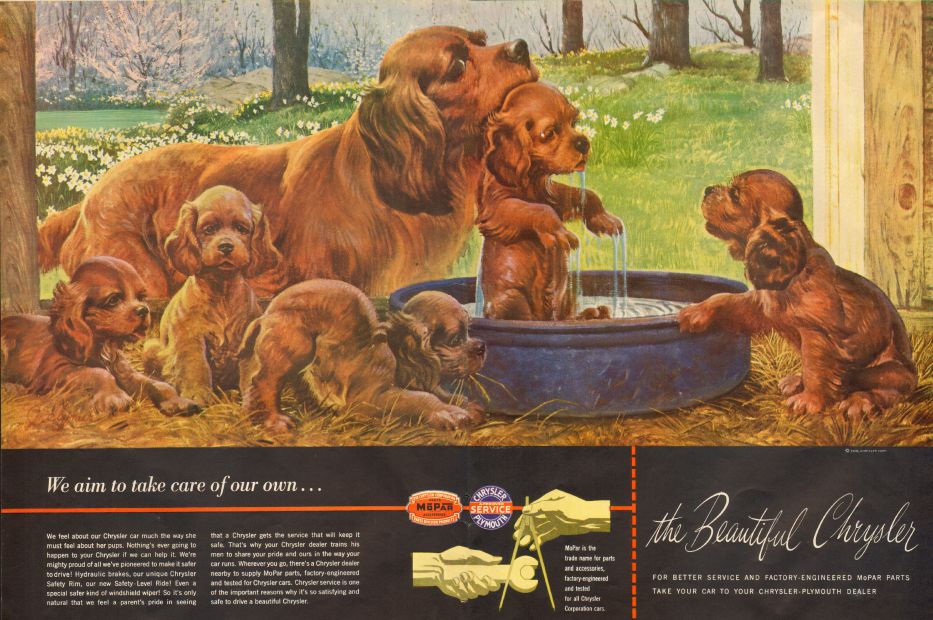
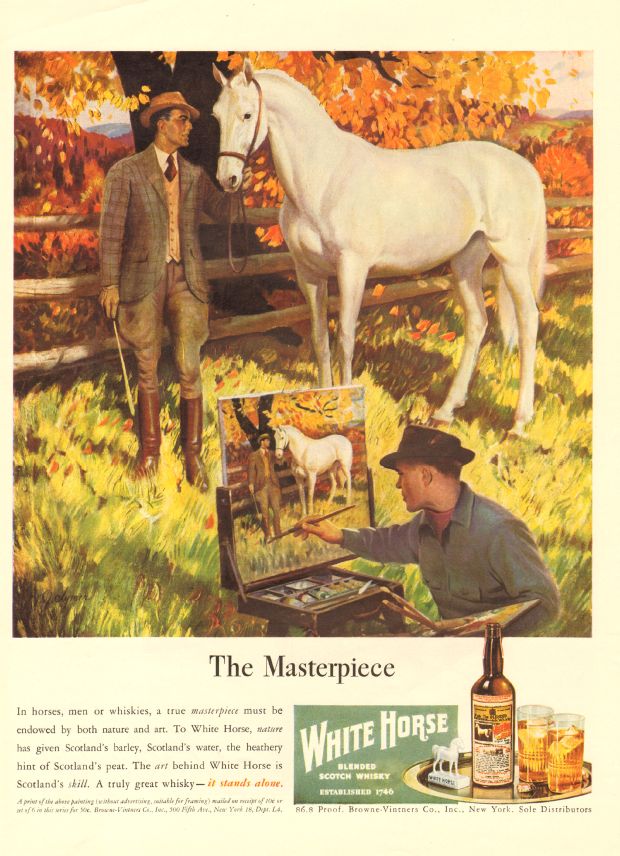
| 1948 Chrysler Mopar Parts | 1947 White Horse Whiskey Ad |
 |  |
$10.00
Size- 21 x 13 ½
Condition- Excellent, two separate pages | $8.00
Size- 10 x 14
Condition- Excellent |
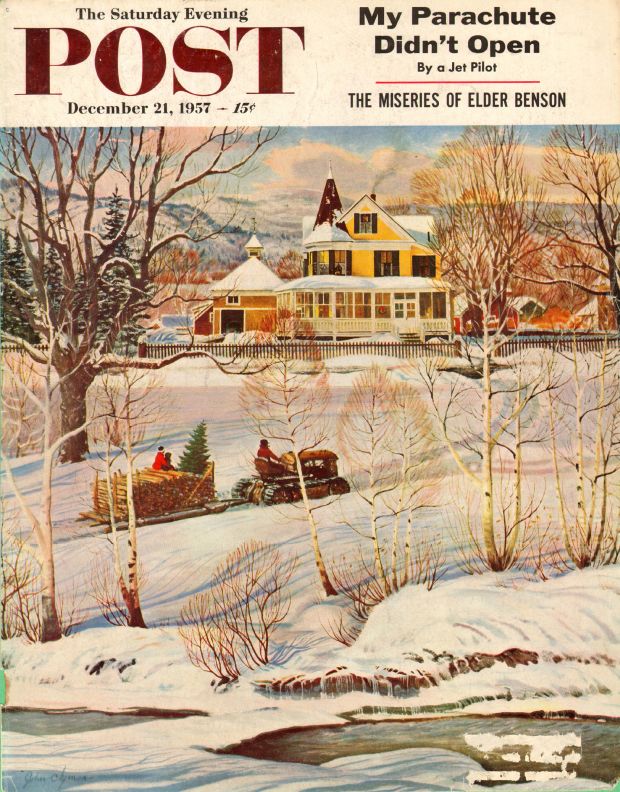
Saturday Evening
Post Cover,
Dec. 11, 1957 |
 |
$5.00
Size- 10 ½ x 13 ½
Condition- Fair,
heavy wear |
|
This information is edited from Wikipedia.
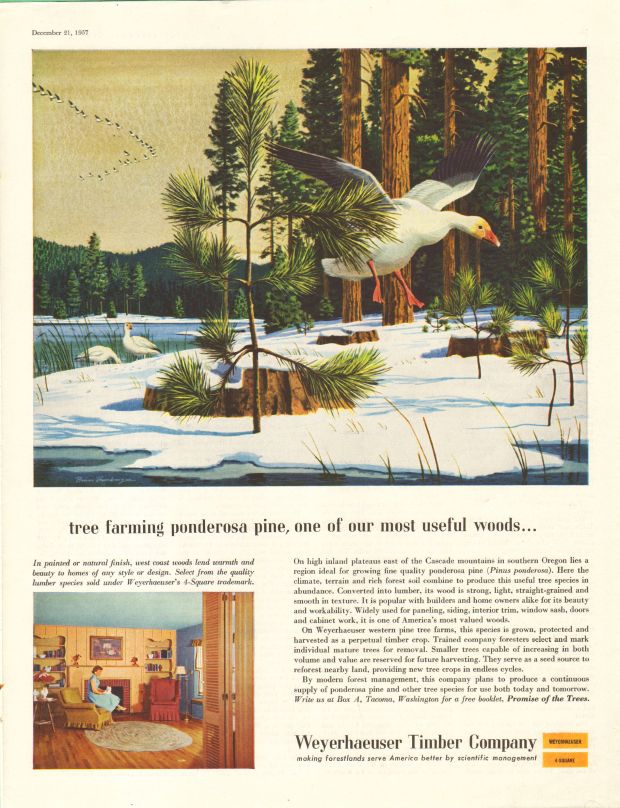
John Clymer (1907 - 1989) was an American painter and illustrator known for his work that captured nature and the American West. Clymer first studied art through the Federal School correspondence course. He continued his study in Canada, where he spent eight years illustrating for Canadian magazines.
In 1937, he moved to Connecticut, where he established his career as an illustrator for American magazines, including Argosy, The Saturday Evening Post, Woman's Day and Field and Stream.
While in the Marine Corps, he illustrated for Leatherneck Magazine and the Marine Corps Gazette. His work in advertising included paintings for White Horse Scotch Whisky, the Pennsylvania Railroad and the Chrysler Corporation.
Clymer did 80 covers for The Saturday Evening Post.
|
|
| |
| |
| 1943 Body By Fisher Ad |
 |
$9.00
Size- 10 ¼ x 13 ¼
Condition- Excellent |
Art by Dean Cornwell
(from Wikipedia)- Dean Cornwell (1892-1960) was an American illustrator and muralist. His oil paintings were frequently featured in popular magazines and books as literary illustrations, advertisements, and posters promoting the war effort. Throughout the first half of the 20th century he was a dominant presence in American illustration. At the peak of his popularity he was nicknamed the "Dean of Illustrators." He served as president of the Society of Illustrators from 1922 to 1926, and was elected to its Hall of Fame in 1959. He served as President of the National Society of Mural Painters from 1953 to 1957.
|
|
| Art by Douglass Crockwell |
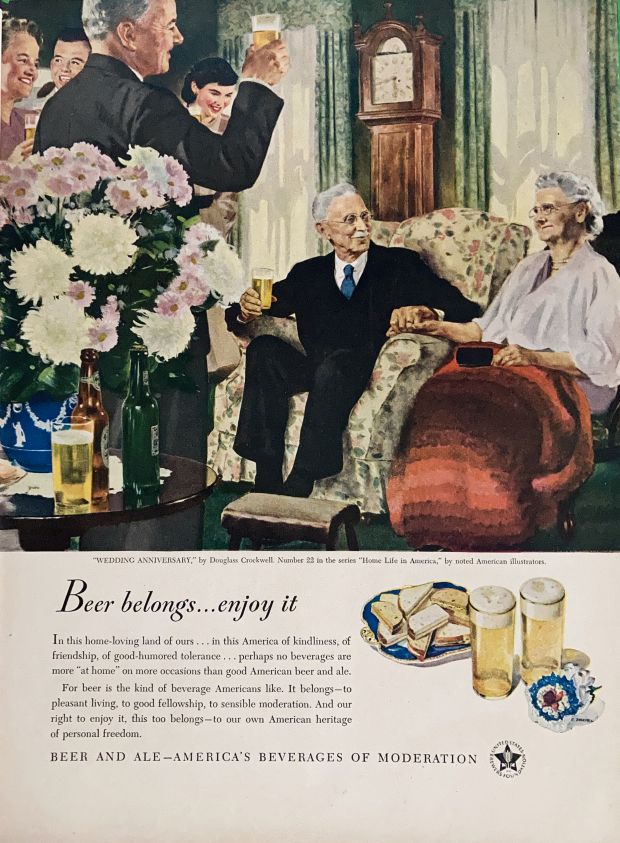
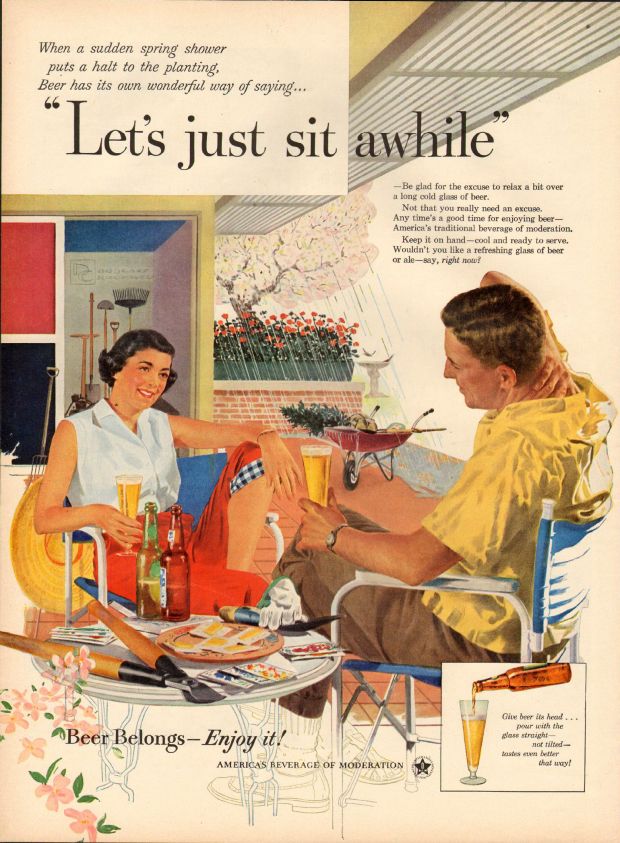
| 1948 Beer Belongs Ad | 1947 American Petroleum Institute Ad | 1956 Beer Belongs Ad |
 |  |  |
$10.00
Size- 10 ¼ x 14
Condition- Excellent | $8.00
Size- 10 ¼ x 14
Condition- Excellent | $9.00
Size- 10 ¼ x 14
Condition- Excellent |
|
This information is edited from Wikipedia.
Douglass Crockwell (1904 - 1968), was an American commercial artist who was most famous for his illustrations and advertisements for the Saturday Evening Post. He had a knack for getting the kind of assignments that were Norman Rockwellesque. His name was even similar to Rockwell's; too much, Crockwell thought, so he'd sign his name to hide the rhyming similarity: "Douglass," "DC," or simply "D." Crockwell had his own style, however, and his incredible realism and facility with subjects ranging from war to illness to family reunions made him one of the most popular artists of the 1940s and 50s. His longest ad campaign was for The Brewing Industry Association. After WWII, the Association created the "Beer Belongs" series, featuring other top illustrators (Gannam, Dohanos, Schaeffer, Briggs, Sundblom), but the majority were still done by Crockwell.
|
|
| Art by Stevan Dohanos |
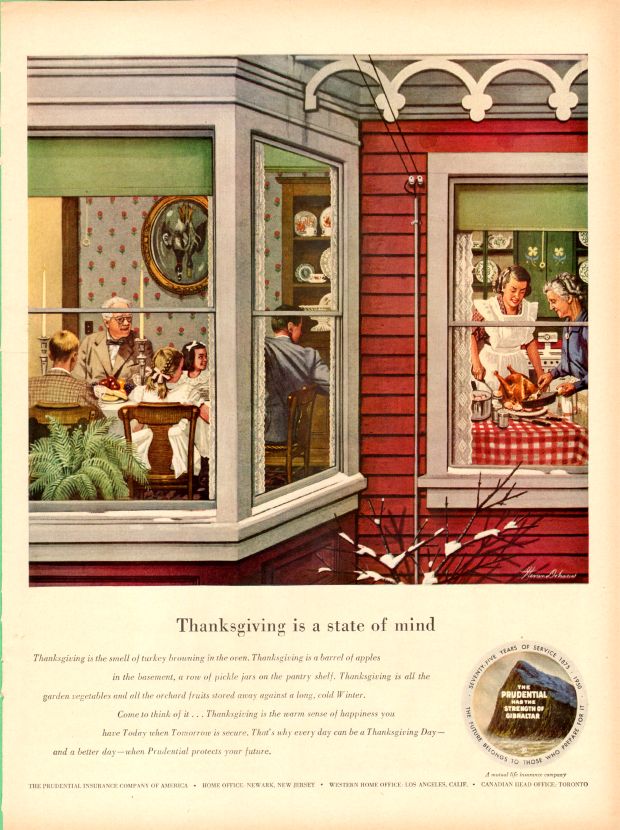
| 1946 Beer Belongs Ad | 1950 Prudential
Insurance Ad | 1958 Coca-Cola Ad |
 |  |  |
$10.00
Size- 10 ¼ x 14
Condition- Excellent | $7.00
Size- 10 ½ x 14
Condition- Excellent | $10.00
Size- 10 ¼ x 13 ¾
Condition- Excellent, tear in right edge |
|
Stevan Dohanos was an artist and illustrator of the social realism school, best known for his Saturday Evening Post covers, and responsible for several of the Don't Talk set of World War II propaganda posters. He was in demand both for advertising and illustration assignments and he was also commissioned to paint murals in public buildings in West Virginia, West Palm Beach, and St. Thomas, Virgin Islands. He created his first Saturday Evening Post cover in 1943. In later years he designed more than 40 stamps for the United States Postal Service and served as design coordinator for the Citizen Stamp Advisory Committee.
|
|
| Art by Albert Dorne |
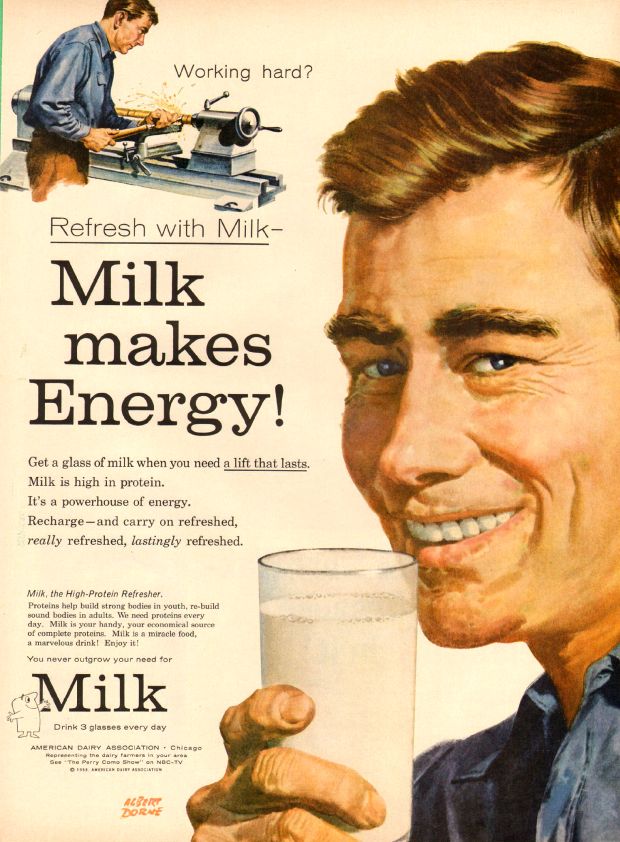
| 1947 Wurlitzer Jukebox Ad | 1950 Imperial Whiskey Ad | 1958 American Dairy Assoc. Ad |
 |  |  |
$9.00
Size- 10 ¼ x 14
Condition- Very good, small tears in left side | $7.00
Size- 10 ¼ x 13 ¼
Condition- Excellent | $7.00
Size- 10 ¼ x 14
Condition- Excellent |
|
Albert Dorne- Despite TB and a heart condition Albert Dorne did well as a young boxer before being floored in his 11th fight (he'd won the first 10). After that he pursued his life-long dream of art. He worked his way up from ad agency gopher to the leading illustrator for magazines like Liberty, The Saturday Evening Post, Life, True, Colliers', and Look. He also did World War II posters, menu art for the Stork Club, and major ad campaigns (Westinghouse, Coke, Goodyear, Wurlitzer, Frigidaire, Pabst Blue Ribbon, Liberty Mutual Imperial Whiskey). This was all without ever taking a formal art class. He had a tremendous impact on countless artists by founding (along with Fred Ludekens) and directing the Famous Artists School. Most Baby Boomers will remember him as the bushy-browed guy in the ads on the back of comic books who asked "Do you like to draw?" |
|
| Art by John Falter |
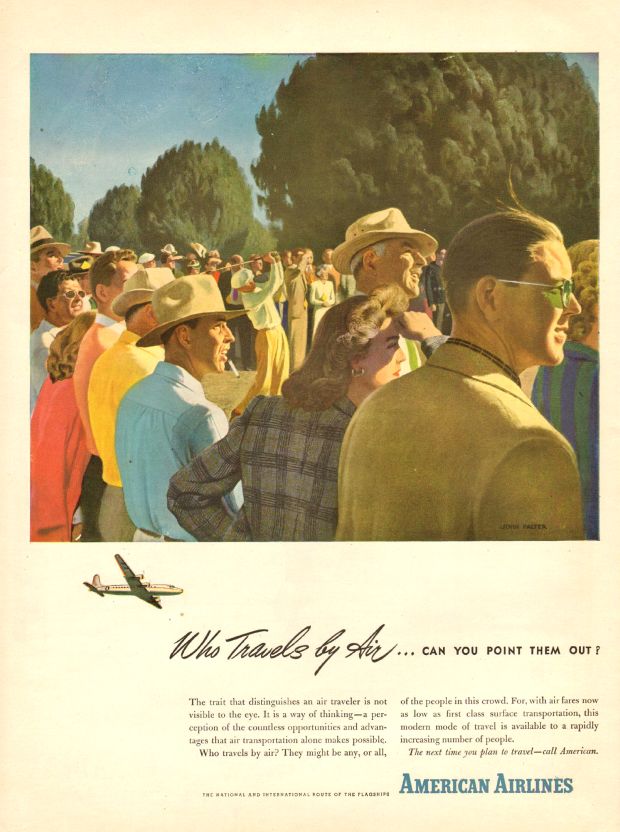
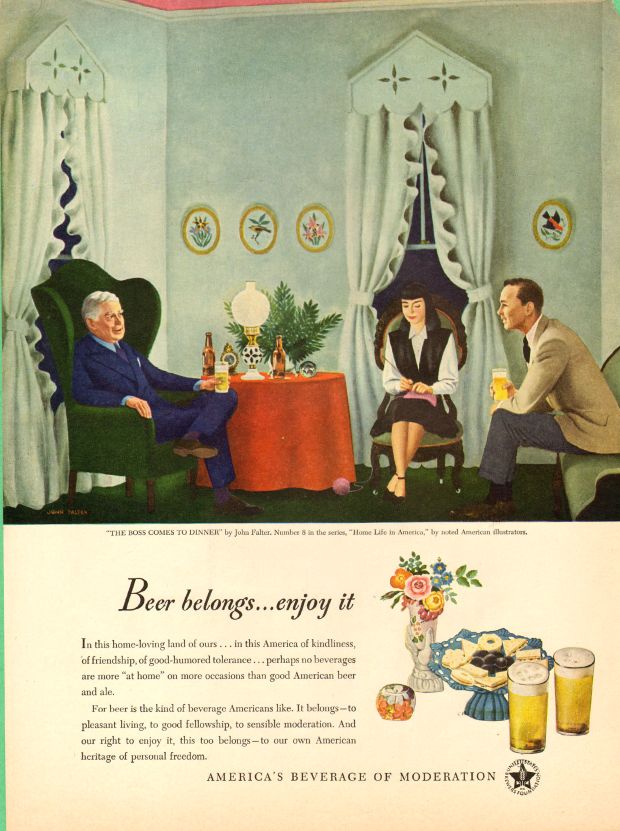
| 1946 American Airlines Ad | 1947 Beer Belongs Ad | 1950 Old Gold Tobacco Ad |
 |  |  |
$7.00
Size- 10 ¼ x 14
Condition- Excellent | $9.00
Size- 10 ¼ x 14
Condition- Excellent | $7.00
Size- 10 ¼ x 14
Condition- Excellent |
|
(from Wikipedia) John Falter (1910 - 1982) was an American artist best known for his many cover paintings for The Saturday Evening Post. His first Post cover is dated Sept. 1, 1943. That cover began a 25-year relationship with the Post, during which Falter produced more than 120 covers for the magazine. His talents were also applied to the American war effort to spur on recruiting drives. Falter designed more than 300 recruiting posters. One popular Falter poster dealt with the loose-lips-sink-ships theme. It showed a broad-shouldered Navy man with the caption, "If you tell where he's going, he may never get there."
Falter's panoramic covers with long views of people were a major departure from the Post's customary close-up designs. In fact. Norman Rockwell himself adjusted to the newer style for a time, which he later referred to as his Falter Period.
During the 1970s and 1980s, after a career crisis brought on by the decline of illustrated magazines, Falter turned to historical and American Western themes, a passion of his. The 3M Company commissioned him to do a series of six paintings in celebration of the American Bicentennial, titled From Sea to Shining Sea. Falter completed more than 200 paintings in the field of Western art, with emphasis on the migration of 1843 to 1880 from the Missouri River to the Rocky Mountains. He was honored by his peers with election to the Illustrators Hall of Fame in 1976, and membership in the National Academy of Western Art in June 1978.
|
|
| 1946 National Confectioners' Association Ad |
 |
$7.00
Size- 10 x 14
Condition- Excellent |
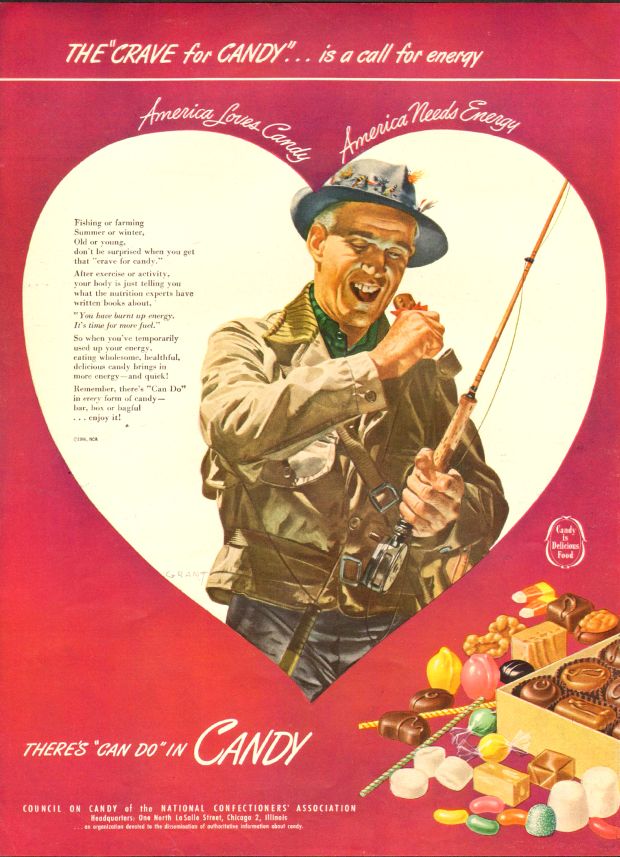
| 1946 National Confectioners' Association Ad |
 |
$7.00
Size- 10 x 14
Condition- Excellent |
Art by Gordon Grant
Gordon Hope Grant was a noted American artist, well-known for his maritime watercolors, and his work with the American Boy Scouts. He was born in San Francisco in 1875, and died in 1962. His best known work is likely his watercolor of the USS Constitution. He also produced war time posters during WW I and illustrations for books such as Penrod, and magazine covers for periodicals such as Saturday Evening Post and illustrations for Boys' Life. He was a member of the Association of American Artists.
|
|
| 1948 Esquire Pin-Up Calendar Ad |
 |
$10.00
Size- 10¼ x 13¼
Condition- Excellent |
Art by Al Moore
Al Moore (1908-1991) played college football at Northwestern University and professional football with the Chicago Bears. After attending classes at Chicago's Art Institute and Academy of Art, he opened a commercial art studio in New York in the late 1930s.
During the war years, Moore painted posters for the government and also took on assignments from Old Gold cigarettes, Cosmopolitan, The Saturday Evening Post and Collier's.
Moore's breakthrough assignment came in 1946 when he was chosen by Esquire to replace Alberto Vargas, the most popular pin-up artist of the day. Among Moore's triumphs at the magazine were his creation of the Esquire Girl, his answer to the Varga Girl; the 1948 Esquire calendar and the rare honor of painting the entire 1949 and 1950 calendars himself. By 1950, his two-page gatefolds in Esquire were collected by millions of Americans.
In the 1950s, his corporate clients included Munsingwear, Hertz Rent-a-Car, and the McGregor Corporation. During the same years, his illustrations appeared in American Magazine, Woman's Home Companion, McCall's, and Woman's Day, and he painted several front covers for The Saturday Evening Post.
When photographs started to replace artwork in magazines and advertising, Moore decided to retire and pursue fine-art painting, including portrait commissions, Shortly after he moved to Crawford, Colorado, he accepted a commission from the United States Olympic Committee for three paintings for their world headquarters that would call attention to the problem of illegal steroid use by athletes.
---
Information on Al Moore from The Great American Pin-Up by Charles G Martignette & Louis K Meisel.
|
|
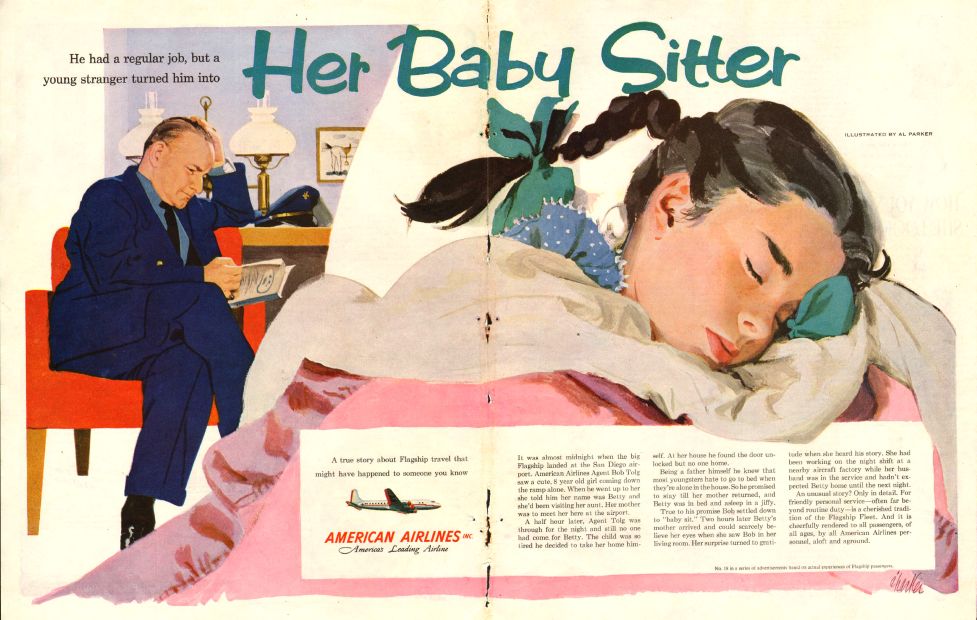
| 1956 2-Page ad for American Airlines |
 |
$7.00
Size- 21 x 14¼
Condition- Very Good- This double page ad is the center spread of a magazine. There are holes in the seam from staples and some slight separation along the seam. There are also some pinholes. |
Art by Al Parker
Al Parker (1906-1985) was an American artist and illustrator. Parker got a break when a cover illustration he did for House Beautiful won a national competition. He soon was producing illustrations for Chatelaine, Collier's, Ladies' Home Journal and Woman's Home Companion. Starting in 1938, he produced a total of 50 covers over a 13-year period for the Ladies' Home Journal. Parker later became part of the art colony in suburban New Rochelle, New York, which was well known for its unprecedented number of prominent American illustrators (more than 50 per cent of the illustrations in the country’s leading publications were done by artists from New Rochelle).
Parker worked in a variety of styles, themes and media. Examples range from children's crayons to acrylics. In cooperation with the magazine's art director, he secretly provided every illustration in an issue of Cosmopolitan, using different pseudonyms, styles and mediums for each story.
He won more than 25 gold medals and awards of excellence in Art Directors Club and Society of Illustrators' shows. He was elected to the Society of Illustrators' Hall of Fame in 1965 and a stamp commemorating his art was issued by the United States Postal Service on Feb. 1, 2001 as part of the American Illustrators Issue series.
|
|
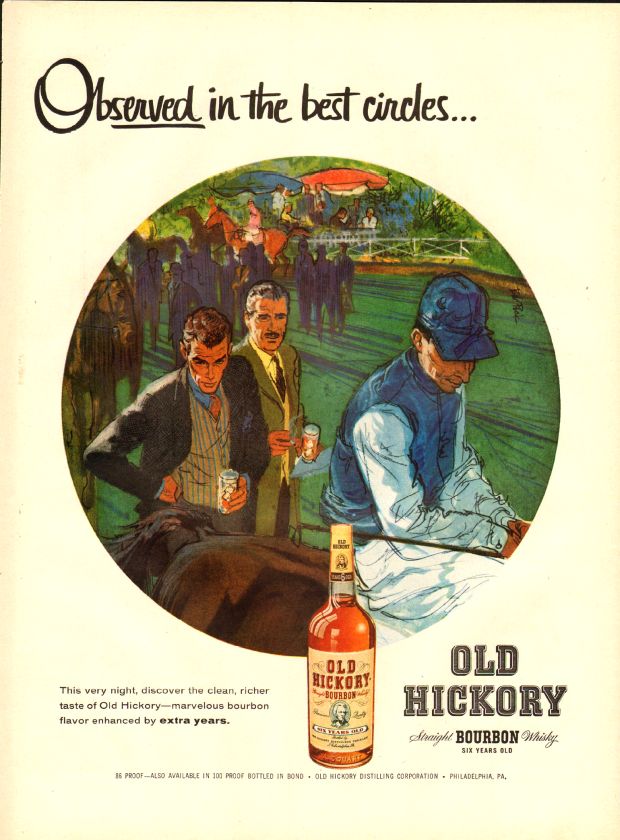
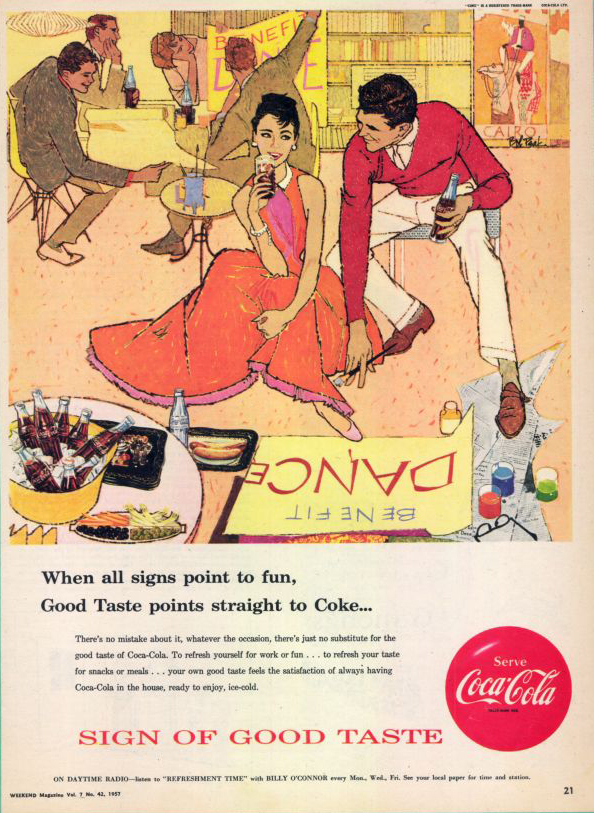
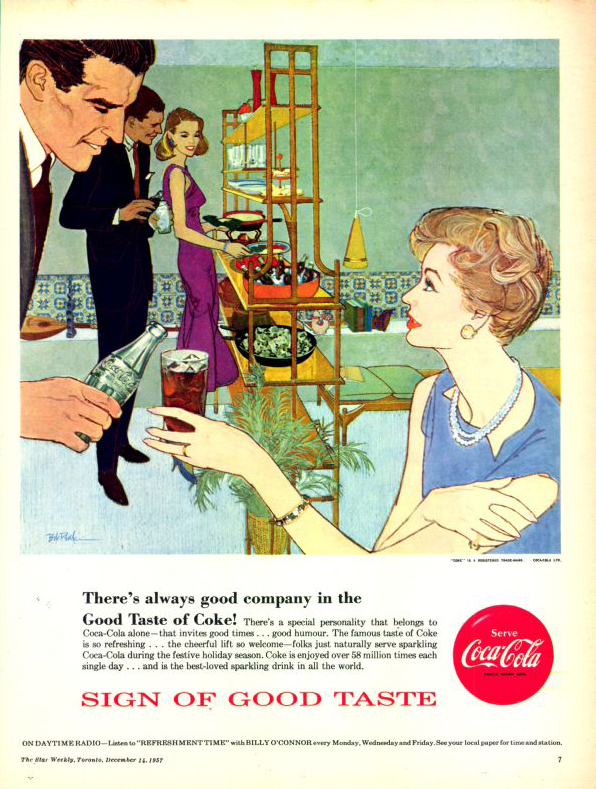
| Art by Bob Peak |
| 1956 ad for Old Hickory Bourbon | 1957 Coca-Cola Ad | 1957 Coke Ad |
 |  |  |
$6.00
Size- 10¼ x 13¾
Condition- Excellent | $10.00
Size- 10½ x 14½
Condition- Excellent | $10.00
Size- 10½ x 14
Condition- Excellent |
|
Bob Peak (1927-1992) was an American commercial illustrator best known for innovative design in the development of the modern movie poster. His artwork has been on the cover of Time magazine, TV Guide, and Sports Illustrated. He also illustrated advertisements and U.S. postage stamps.
After serving the military during the Korean War, Peak transferred to the Art Center College of Design in Los Angeles, California, graduating in 1951. In 1953, he moved to New York City, landed an Old Hickory Whiskey advertising campaign. His work went on to appear in major advertising and national magazines. In 1961 United Artists studio hired him to design the poster images for the film West Side Story. The success of Peak's work on that film led to work on more posters including the big-budget musicals My Fair Lady and Camelot. |
|
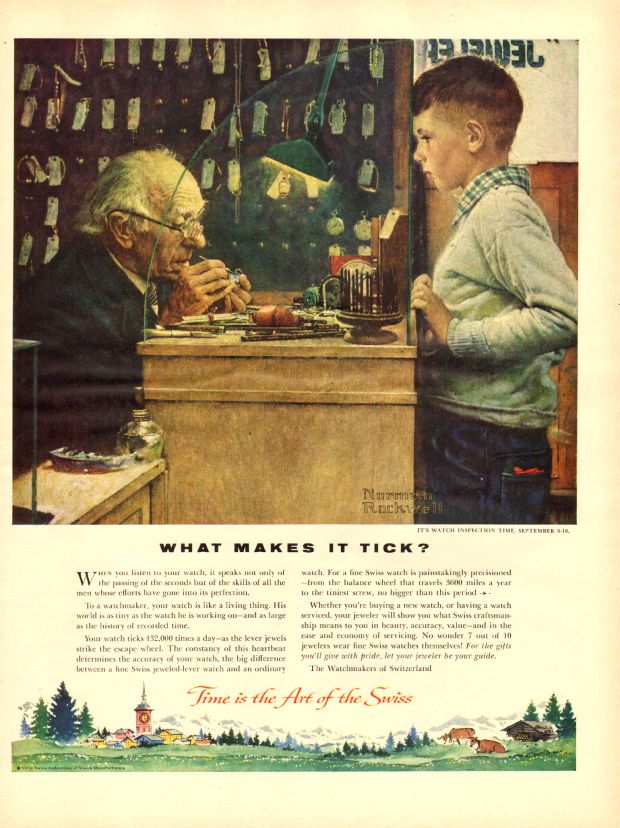
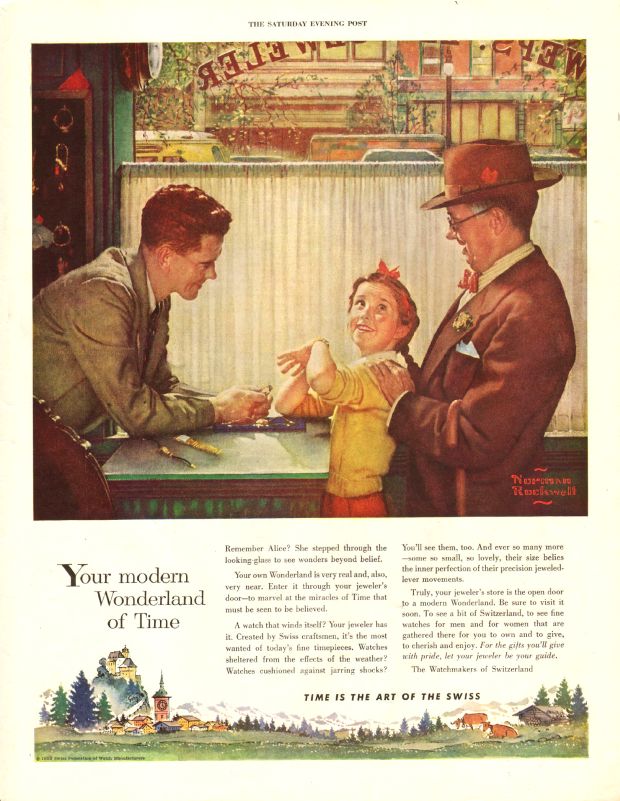
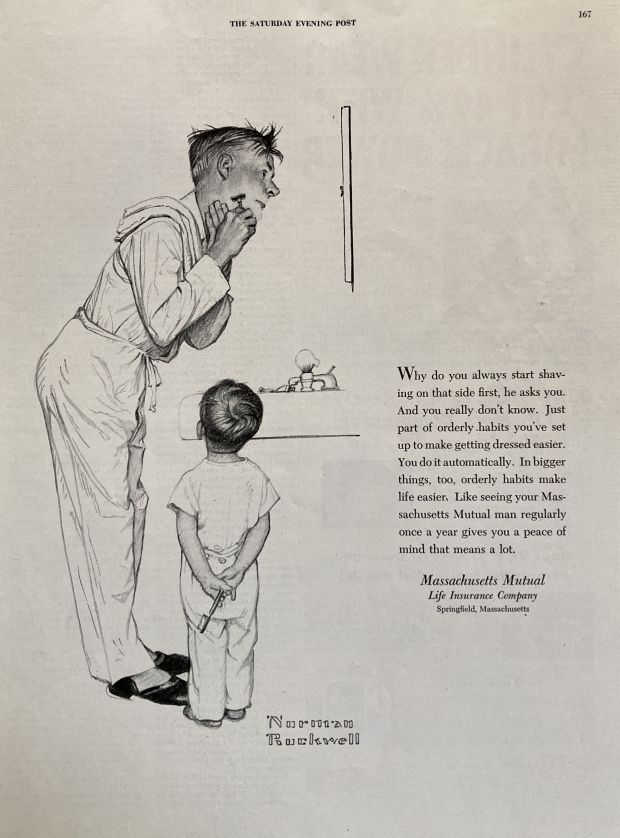
| Art by Norman Rockwell |
| 1954 ad for Watchmakers of Switzerland | 1955 ad for Watchmakers of Switzerland | 1953 Massachusetts Mutual Ad |
 |  |  |
$10.00
Size- 10¼ x 14
Condition- Excellent | $10.00
Size- 10½ x 13½
Condition- Excellent | $5.00
Size- 10 x 13½
Condition- Excellent |
|
Norman Rockwell (1894-1978) was one of America’s most prolific and successful commercial artists. His idealized depictions of American life are still popular with nostalgia-minded Baby Boomers. Most of us are familiar with his many magazine covers but he also illustrated many ads and literary efforts.
Norman Rockwell was a prolific artist, producing more than 4,000 original works in his lifetime. He published 323 original covers for The Saturday Evening Post over 47 years. Rockwell's success on the cover of the Post led to covers for other magazines of the day, including the Literary Digest, the Country Gentleman, Leslie's Weekly, Judge, Peoples Popular Monthly and the original Life magazine.
Rockwell also was commissioned to illustrate more than 40 books, including Tom Sawyer and Huckleberry Finn. |
|
| 1946 Coca-Cola Ad |
 |
$8.00
Size- 10½ by 14
Condition- Very Good, it was the back cover of a magazine and so shows signs of wear around the edges and a few light creases. A subscriber stamp is on the bottom right edge. |
Art by James Schucker
James Schucker at the age of 16, took top honors in the International Water Color Show in Chicago. He studied at the Art Institute of Chicago and the Grand Central Art School.
Magazine illustration took him away from the fine-art field and his work included covers for the Saturday Evening Post, Redbook, and numerous other magazines.
One of his major works was a 48-foot mural mounted on the wall of the tea room at the NYC Botannical Gardens in the early 1950's. It was commissioned by the Lorillard Tobacco Co. to commemorate its 200 years growth.
|
|
| 1943 Saturday Evening Post Cover |
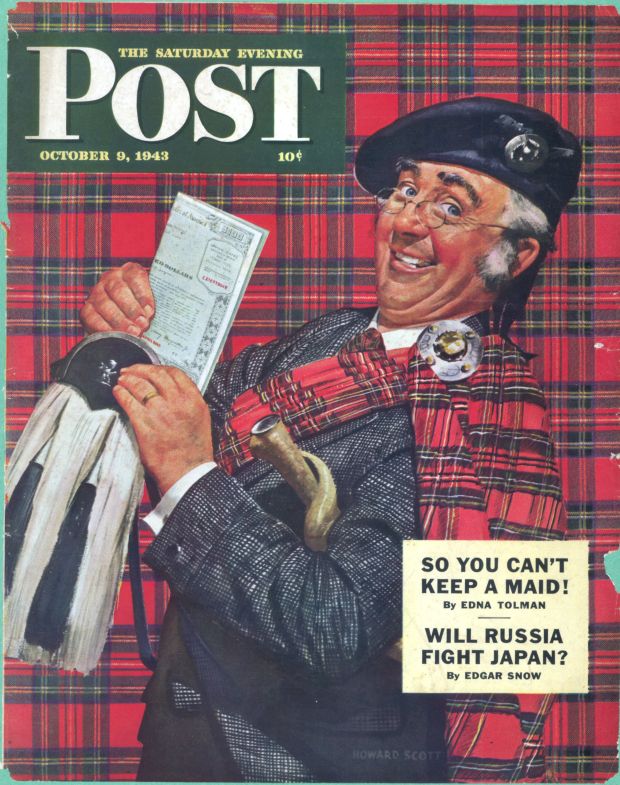 |
$8.00
Size- 10½ by 13½
Condition- Very Good, damaged on edges, especially right side. |
Art by Howard Scott
(from The Saturday Evening Post archives)- Howard Scott (1902-1983) was a billboard designer for many American companies in the mid-twentieth century. He was known for designing billboards with clever one liners and large pictures of friendly, everyday people on them. Scott lived in Manhattan where he could look out over Rockefeller Plaza as he worked on advertisements for companies like Heinz Ketchup, Nash Automotive, and Campbell’s Soup. In the 1940s, Scott won two of the top awards at the 16th Annual Exhibition of Outdoor Advertising from the Art Directors Club of Chicago. His Heinz poster won him the gold medal, while his Nash Motors automobile poster won him the silver medal. Scott served in the Navy during World War II, where he illustrated posters for the U.S. War Information Center. He illustrated 13 covers The Saturday Evening Post from 1941-1945.
|
|
| Art by Haddon Sundblom |
| 1948 Coke on Train Ad | 1948 Coke Soda Fountain Ad | 1948 Beer Belongs Ad |
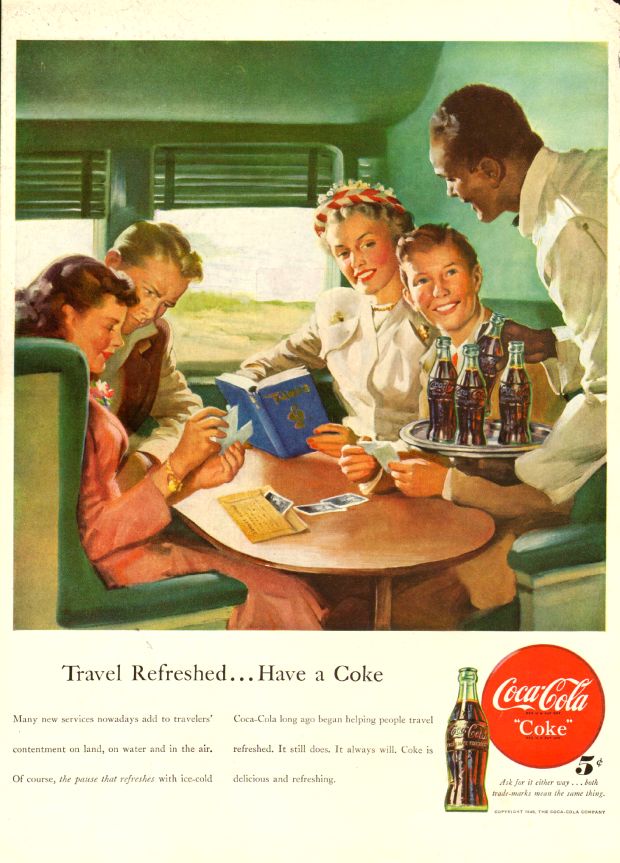 |  |  |
$10.00
Size- 10½ x 13½
Condition- Excellent | $9.00
Size- 10½ x 14
Condition- Excellent, address stamp, bottom right | $9.00
Size- 10 x 13½
Condition- Excellent, small tears on edge |
| 1958 Coca-Cola Santa Ad |
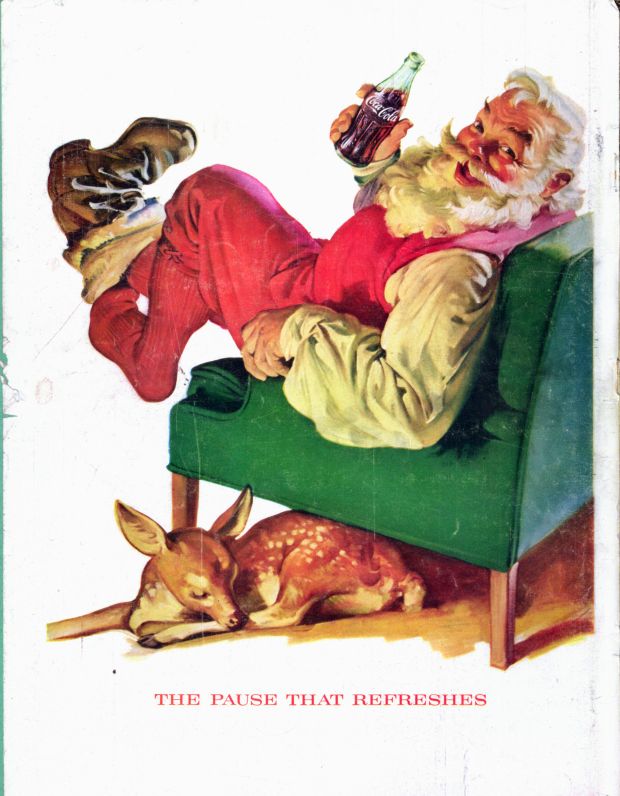 |
$8.00
Size- 10½ by 14
Condition- Acceptable, tear on bottom edge, rough on left |
|
Haddon Sundblom (1899-1976) was a famed advertising illustrator best known for creating the Coca-Cola Santa Claus. Probably the second best known commercial artist of his day, after Norman Rockwell, he was known in some circles as "the greatest advertising illustrator of them all."
According to the Coca-Cola company "For inspiration, Sundblom turned to Clement Clark Moore's 1822 poem A Visit From St. Nicholas (commonly called 'Twas the Night Before Christmas). Moore's description of St. Nick led to an image of Santa that was warm, friendly, pleasantly plump and human. For the next 33 years, Sundblom painted portraits of Santa that helped to create the modern image of Santa - an interpretation that today lives on in the minds of people of all ages, all over the world."
Achieving the pinnacle of his profession during the golden age of posters and billboards in America (the 1920s through the 1940s) Sundblom, was a legend in the advertising and creative industry. Among his other noted commercial works were illustrations for Maxwell House, Colgate-Palmolive, Nabisco, Packard, Buick, and Pierce-Arrow, as well as creation of the "Quaker Man" for Quaker Oats. |
| 1947 Phillips Petroleum Ad |
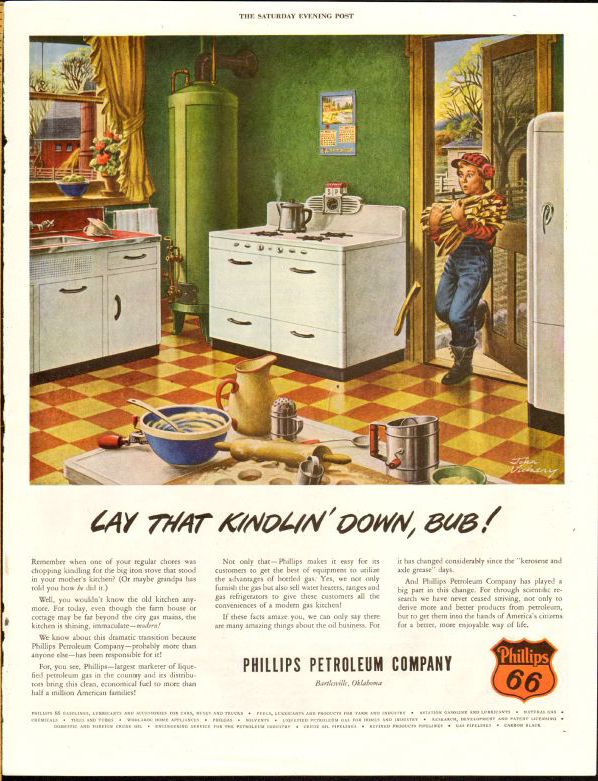 |
$5.00
Size- 10 by 13
Condition- Excellent |
Art by John Vickery
John Vickery was an Australian artist who, after studying at the National Gallery School before WWII, left Australia to live the life of the young and curious artist, moving first to London and then ultimately to New York. In New York he became a successful illustrator and painter, being the only Australian artist to be part of the New York School, friendly with Guston, de Kooning, Pollock and Joan Mitchell during the 1950s. Vickery died in 1983.on Center. He illustrated 13 covers The Saturday Evening Post from 1941-1945.
|
|
| Art by Harold Von Schmidt |
| 1948 Fort Apache Movie Ad | 1958 John Hancock Insurance ad |
 |  |
$10.00
Size- 21 x 13 ½
Condition- Excellent, two separate pages | $7.00
Size- 10 x 14
Condition- Excellent |
|
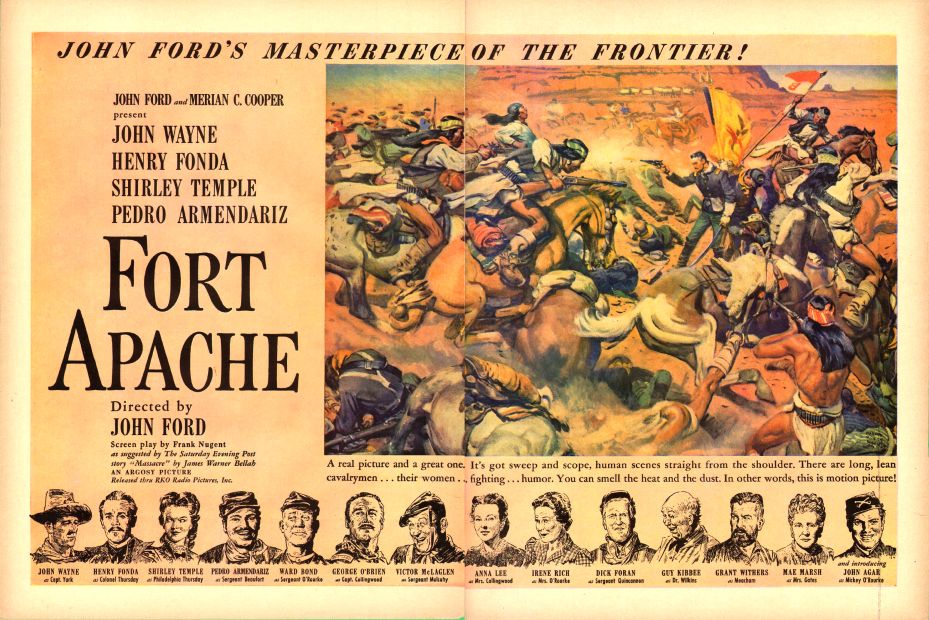
Harold Von Schmidt (1893-1982) painted Western scenes so vivid and full of life that it seems he must have actually been on the spot to witness wagon trains heading west, buffalo hunts, and cowboys on the range. Born in California in 1893, Von Schmidt was too young to have experienced the old West, but he absorbed its romance from his grandfather, who had come to California in a wagon train in 1849, and claimed to be the first white man to see Yosemite Valley.
As a youth, von Schmidt worked as a cowhand and a construction worker. In 1920 and 1924, he was on the United States Olympic Rugby team. After studying at the California College of Arts and Crafts, he apprenticed himself to Maynard Dixon, one of the foremost California painters of the time, paying for his instruction by modeling for Dixon.
Moving to New York in 1924, Von Schmidt began to make a name for himself as an illustrator. In 1944, Von Schmidt was recruited by the Air Force to become a war correspondent in Europe. He focused on depicting the small details of a soldier’s everyday life, and flew on a number of bombing missions. Later, he was sent to Japan and recorded scenes of the occupation: ordinary Americans doing mundane tasks in a strange land.
Twelve of Von Schmidt’s paintings depicting the westward trek and the Gold Rush of 1849 hang in the Governor’s office in Sacramento, California, and five Civil War paintings are in the permanent collection of the United States Military Academy at West Point. |
|
| | Art by Jon Whitcomb |
| 1947 Community Silver Ad | 1948 Community Silver Ad (black) | 1948 Community Silver Ad (red) |
 |  |  |
$7.00
Size- 10¼ x 14
Condition- Excellent | $5.00
Size- 10½ x 15
Condition- Excellent | $4.00
Size- 10¼ x 13
Condition- Very Good, stained on edges |
| 1951 General Electric Sunlamp Ad |
 |
$6.00
Size- 10½ by 13½
Condition- Excellent |
|
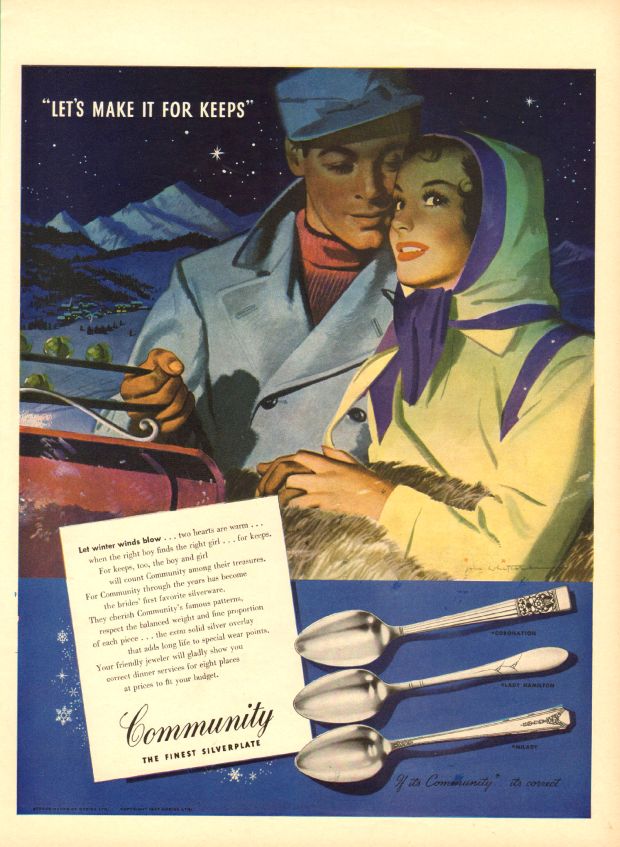
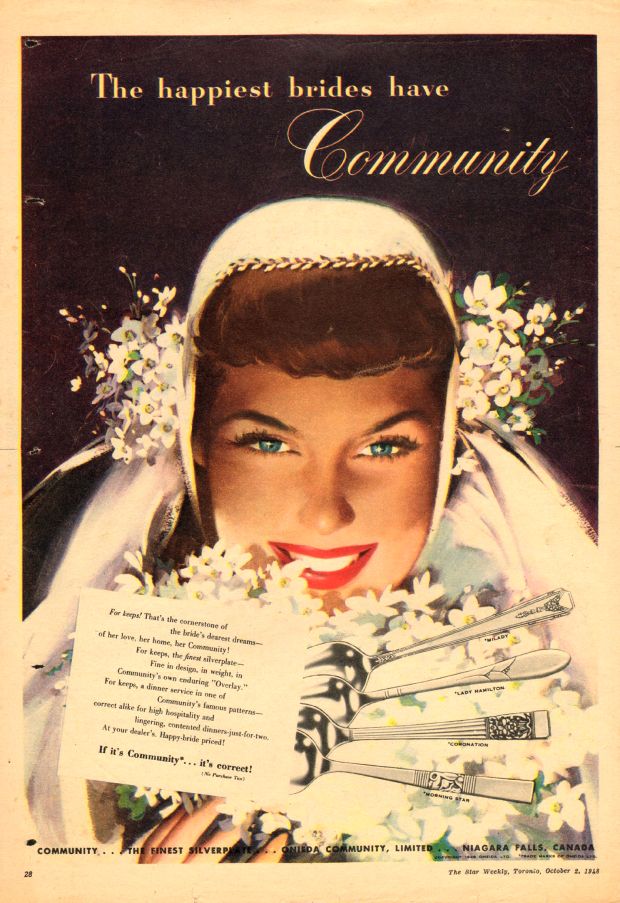
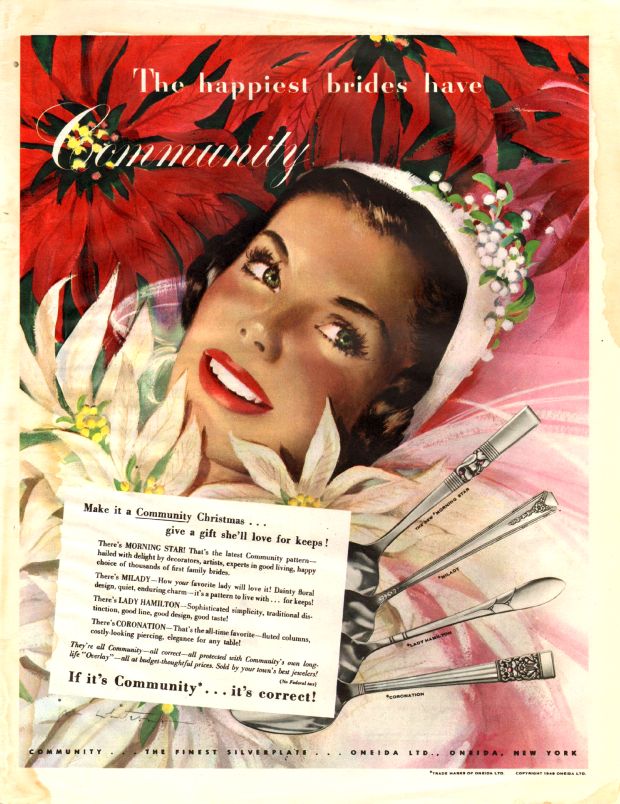
Jon Whitcomb (1906-1988) was an American illustrator. He was well known for his pictures of glamorous young women. Whitcomb started drawing illustrations for student publications while a student at Ohio State, and worked summers painting posters for a theater in Cleveland, Ohio.
After he graduated, Whitcomb found work making travel and theater posters and advertising illustrations. In 1934 he moved to New York City and joined with Al Cooper to found the Cooper Studio. He was a pioneer in the switch from oil to gouache for illustrations. The different qualities of gouache compared to oil led to changes in the design of Whitcomb's illustrations. He zoomed in on people, usually pretty, young city women, and reduced the background to simple design elements. His new style of illustrations soon appeared in Collier's Weekly, Good Housekeeping and other magazines.
During World War II Whitcomb was commissioned a Lieutenant, Junior Grade in the United States Navy. After a variety of duties, he was assigned as a combat artist for the invasions of Tinian, Saipan, and Peleliu. |
|
| 1948 full-page ad for
Springmaid Fabrics |
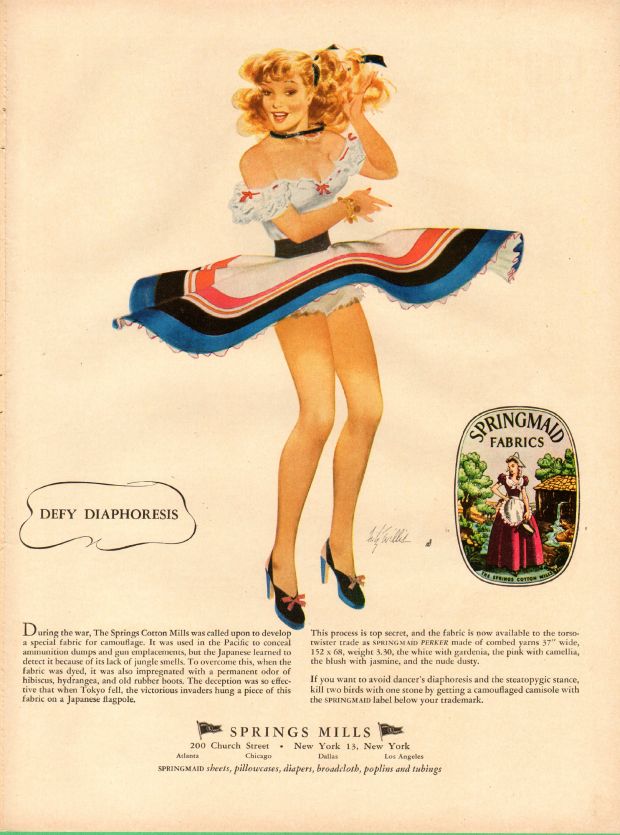 |
$8.00
Size- 10¼ x 14
Condition- Excellent |
Art by Fritz Willis
Well-known commercial artist Fritz Willis (1907 - 1979) handled ad work for Pepsi, Quality Papers, Max Factor, Purex, Sunkist, Crown Zellerbach, SpringMaid Sheets and others.
By 1947, Willis had obtained a position as pinup artist for Esquire magazine, for which he is best known, producing iconic images of women known as the Willis Girls. He also illustrated stories for Esquire, Saturday Evening Post, Redbook, Collier's, and covers for Ice Follies programs from 1952-1969. He wrote several art instruction books.
|
|
|
|